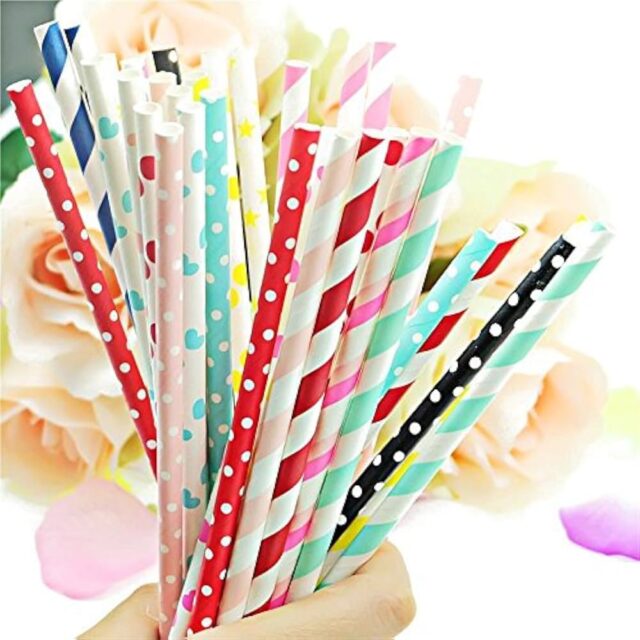
Few disposable products have sparked as much debate in America as the humble paper straw. What started as a niche eco-friendly swap in coastal cities has grown into a multibillion-dollar industry — and, more recently, a political flashpoint. If you’ve ever wondered why your iced coffee suddenly came with a soggy paper tube instead of a plastic straw, or why that trend may already be reversing, this guide breaks down everything happening with paper straws across the United States right now.

Paper straws have evolved from a niche eco-friendly swap into a multibillion-dollar industry and a major national talking point across the United States
A paper straw is a single-use drinking straw made from layers of paperboard or kraft paper, rolled and glued into a tube shape. Manufacturers typically apply a food-safe coating to help the straw resist sogginess for the duration of a drink. Paper straws are marketed as biodegradable and compostable alternatives to polypropylene plastic straws, which can take centuries to break down in the environment.
The shift toward paper straws in the US accelerated after 2018, when Seattle became the first major American city to ban plastic straws outright. California followed in 2019 with a first-in-the-nation state law restricting full-service restaurants from automatically handing out plastic straws. National chains, retailers, and airlines quickly followed suit, partly in response to viral footage of marine animals harmed by plastic waste and partly to align with corporate sustainability pledges.
By the early 2020s, paper straws had become the default option at thousands of restaurants, cafés, and quick-service chains nationwide, even in states without a formal mandate, simply because distributors and franchise supply chains standardized on them.
The paper straw industry has grown into a genuinely large global business, and North America is consistently identified as the region with the largest share of that market. Multiple market research firms track the category, and while their exact figures differ, the pattern is consistent: strong double-digit annual growth driven by regulation, foodservice demand, and rising consumer awareness of plastic pollution. We break down the specific figures and forecasts in our companion article on US paper straw market size and growth trends.
In February 2025, the paper straw story took an unexpected turn. President Trump signed Executive Order 14208, “Ending Procurement and Forced Use of Paper Straws,” directing federal agencies to stop purchasing paper straws and to develop a national strategy discouraging their use. The order criticized paper straws as “nonfunctional,” more expensive to manufacture than plastic, and containing chemicals that “may carry risks to human health.”
This federal order does not override state or city laws — California, New York, Oregon, and other states with existing straw restrictions remain unaffected at the local level — but it has reshaped the national conversation and emboldened states considering rollback legislation. We cover this in full detail in our article on the paper straw executive order.
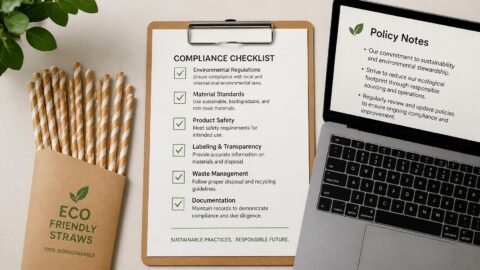
Navigating the US paper straw market requires understanding a complex patchwork of state regulations, federal executive policies, and evolving scientific research.
One of the most surprising developments in the paper straw debate is scientific, not political. Multiple peer-reviewed studies — including a widely cited 2021 US study and a 2023 Belgian study — found that a majority of paper straws tested contained PFAS (“forever chemicals”), often at higher rates than plastic straws. These chemicals are typically added as a water-resistant coating. While researchers note the concentrations are generally low and the health risk from occasional straw use is limited, the finding undercuts the “paper is automatically greener” assumption that drove the straw switch in the first place. Full details are in our dedicated piece on PFAS in paper straws.
The US doesn’t have one national paper straw law — it has a patchwork of state and city rules. Roughly a dozen states, including California, New York, Oregon, Washington, New Jersey, Vermont, Maine, and Rhode Island, restrict plastic straws to a “by request only” basis in at least some settings, effectively pushing restaurants toward paper as the default. Meanwhile, states like Florida have moved to prevent local governments from mandating paper-only straws at all. Ourstate-by-state law guide has the full breakdown.
There’s no single right answer — it depends on what you’re optimizing for: ocean pollution, carbon footprint, manufacturing cost, or user experience. Plastic straws are cheaper, sturdier, and don’t turn to mush in a milkshake, but they persist in the environment for centuries and are a common form of marine litter. Paper straws break down faster in nature and avoid the microplastic problem, but they cost more to produce, have a higher carbon footprint per unit in some analyses, and — per the PFAS research above — aren’t automatically the “clean” choice consumers assume. See our full paper vs. plastic straw comparison for a side-by-side breakdown.
If you run a restaurant, café, bar, or bubble tea shop, sourcing paper straws in the US now means navigating supplier options (domestic brands like Aardvark vs. overseas manufacturers), compliance with your state’s straw laws, and cost-per-unit at scale. Our guides on top US paper straw manufacturers and how to buy bulk paper straws walk through exactly how to source responsibly and affordably.
Are paper straws banned or required in the US? Neither, nationally. There is no federal ban on plastic straws or federal mandate for paper straws. Roughly a dozen states restrict plastic straws to “by request,” which pushes many businesses toward paper as their default option, but the specifics vary widely by state and city.
Did Trump ban paper straws? Not exactly. His February 2025 executive order stops the federal government from purchasing or providing paper straws in federal buildings and discourages federal contracts that favor paper over plastic. It does not ban paper straws for private businesses or override state laws.
Do paper straws actually decompose faster than plastic? Yes, in most composting and marine environments, paper straws break down considerably faster than polypropylene plastic straws, which can take hundreds of years to degrade.
Are paper straws safe to drink from? Generally yes, though studies have found trace PFAS compounds in a majority of paper straw brands tested, typically at low concentrations.
Paper straws in the US sit at the intersection of environmental policy, consumer behavior, manufacturing economics, and now partisan politics. Whether your interest is regulatory compliance, sourcing for your business, or simply understanding what’s really in your drink, the sections above — and the linked deep-dive articles — cover the full picture as of 2026.