Saudi Arabia’s Vision 2030 has pushed sustainability from a talking point into an operational requirement for many businesses, particularly in Riyadh, where rapid urban development is paired with growing public attention to environmental impact. This case study looks at how a mid-sized specialty coffee chain based in Riyadh — operating twelve branches across neighborhoods including Al Olaya, Al Malqa, and King Abdullah Financial District — approached a full transition from plastic to paper straws.

As Riyadh’s specialty coffee scene grows under Vision 2030, local cafe chains are successfully balancing guest experience and environmental responsibility.
Before the transition, the chain was using standard plastic straws sourced through a regional distributor, at a cost the operations team considered low but unremarkable. The decision to switch wasn’t driven by a single regulatory mandate — Saudi Arabia’s plastic policies were still evolving at the time — but by a combination of factors: customer feedback forms increasingly mentioning plastic waste, a desire to differentiate the brand in a crowded specialty coffee market, and internal pressure from younger staff and management who wanted the company’s environmental practices to match its public image.
The operations director’s primary concern wasn’t sourcing paper straws — plenty of suppliers were willing to sell small quantities. The challenge was finding a supplier who could guarantee consistent quality across a large enough order volume to serve twelve locations daily, without straws degrading in iced beverages, which made up more than 60% of the chain’s drink menu, especially during Riyadh’s long, hot summer months.
An early trial with one supplier ended poorly: straws softened within 15–20 minutes in cold drinks, leading to visible customer complaints and returned orders during a two-week pilot at a single flagship branch.
The chain restarted its search with more specific criteria: straws needed to maintain structural integrity in cold beverages for at least 45 minutes, come with food-safety documentation suitable for Saudi import requirements, and be available in bulk with predictable lead times through the port of Jeddah or Dammam.
After evaluating three suppliers, the chain selected a manufacturer offering double-wall paper straw construction, which held up significantly better in iced drinks than the single-ply straws used in the initial trial. The switch was rolled out gradually — two branches per week — allowing staff to adjust service routines and allowing management to monitor customer feedback in real time before scaling to all twelve locations.

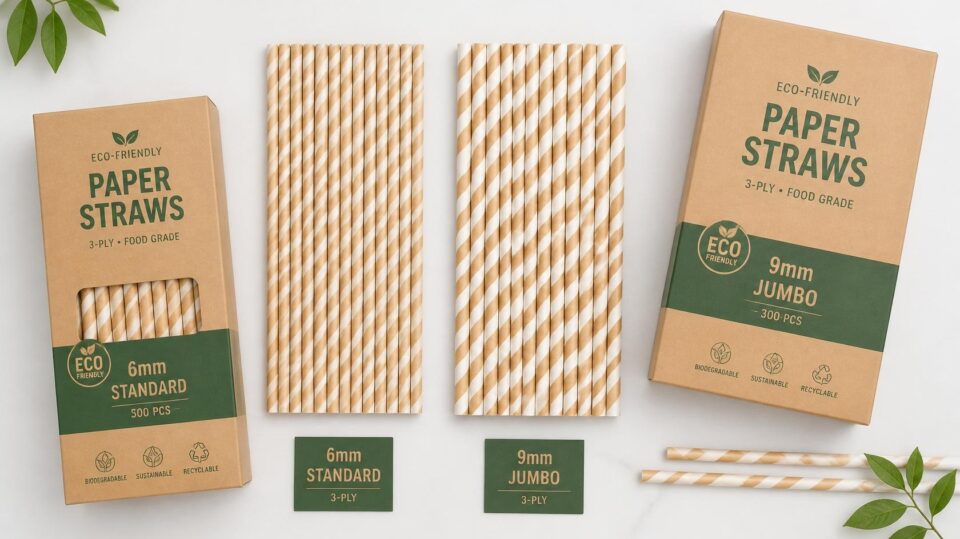
Ensuring structural durability in iced beverages during Riyadh’s hot summer months requires rigorous supplier testing and high-quality 3-ply or double-wall paper straw construction.
Within two months, all twelve branches had fully transitioned. Complaints about straw quality dropped to near zero after the supplier switch, compared to the double-digit weekly complaints during the failed initial pilot. Customer-facing signage explaining the switch to paper straws was well received, with several branches reporting positive social media mentions from customers who noticed the change.
On the cost side, the chain absorbed a modest per-unit increase compared to plastic straws but did not pass this cost onto customers, treating it instead as a brand investment. Staff reported that the operational learning curve was minimal — the biggest adjustment was training baristas to place straws in drinks slightly later in the preparation process to reduce sogginess before the drink reached the customer.
This case illustrates a pattern seen across many Riyadh-based food-service transitions: the failure point is rarely willingness to switch, it’s supplier quality. Businesses that treat their first paper straw supplier as final, rather than testing thoroughly under real operating conditions, often end up with the kind of customer-facing failures that create internal resistance to the entire sustainability initiative.
For suppliers targeting the Riyadh market, the lesson is equally clear: durability testing data and clear import documentation aren’t optional extras — they’re often the deciding factor between winning a contract and losing one after a failed pilot.