Walk down the eco-friendly aisle of any supplier catalog and you’ll see three terms thrown around almost interchangeably: compostable, biodegradable, and paper. They are not the same thing, and choosing the wrong one can undermine your sustainability goals — or your customers’ drinking experience. Let’s settle the debate.
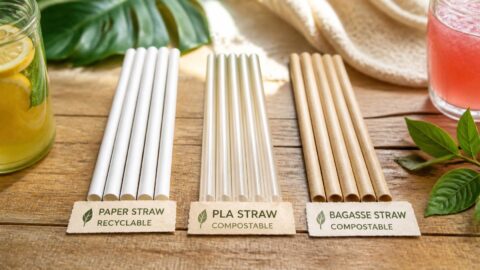
While compostable, biodegradable, and paper straws are often grouped together, their materials, breakdown timelines, and environmental impacts differ significantly.
Here’s the catch: every compostable product is biodegradable, but not every biodegradable product is compostable. “Biodegradable” is an unregulated marketing term in many countries, which means a plastic straw with a biodegradable additive might still take decades to break down and could leave microplastic fragments behind.
| Feature | Compostable Straws | Biodegradable Straws | Paper Straws |
|---|---|---|---|
| Raw material | PLA, bagasse, wheat, bamboo | Often plastic + additive | Wood pulp |
| Certified breakdown time | Yes (45–180 days industrial) | Rarely specified | Yes, similar range |
| Leaves microplastics? | No (if certified) | Possibly | No |
| Durability in cold drinks | Good (2–4 hrs) | Varies | Moderate (1–2 hrs before softening) |
| Durability in hot drinks | Limited unless heat-treated | Varies | Good |
| Cost per 1,000 units | $$ | $ | $ |
| Best for | Cafés, restaurants, eco brands | Not recommended for green claims | Fast food, quick-service |
| Greenwashing risk | Low (if certified) | High | Low |
The main limitation isn’t the material — it’s infrastructure. Many cities still lack industrial composting facilities, so a compostable straw tossed in regular trash ends up in a landfill where it may not break down meaningfully faster than plastic. Businesses need a composting pickup partner or clear customer education to unlock the full benefit.
This is where most greenwashing happens. Without a certification body backing the claim, “biodegradable” can mean anything from “breaks down in 6 months” to “breaks down in 400 years.” Regulators in the EU, UK, and several US states have started cracking down on unverified biodegradable claims for exactly this reason.
Loved for hot drinks, criticized for texture. Paper straws can go mushy quickly in cold, acidic, or carbonated drinks, leading to customer complaints. They’re also often coated with a thin plastic or wax lining for durability — which, ironically, can reduce their compostability unless specifically labeled compostable-coated.
Use this if you’re choosing for your business:

Choosing the right straw depends heavily on your beverage menu, customer experience goals, and local municipal waste management infrastructure.
Is bamboo a compostable or biodegradable straw? Bamboo straws are typically reusable (washable, multi-use) rather than single-use compostable, though bamboo pulp is also used to manufacture single-use compostable straws.
Which option has the best customer experience? Bagasse-based compostable straws are frequently rated closest to plastic in mouthfeel and durability, followed by PLA, then paper.
Can I mix compostable and paper straws in the same order to cut costs? Yes — many restaurants offer compostable straws for cold drinks and paper for hot drinks as a cost-effective hybrid approach.
If your goal is a genuinely lower environmental footprint backed by evidence, certified compostable straws are the strongest choice — provided you pair them with proper disposal education or composting pickup. Paper remains a dependable fallback, especially for hot beverages. Uncertified “biodegradable” straws should be treated with skepticism and avoided for any serious sustainability claim.
Next up: we dig into what actually happens to a compostable straw once it leaves your hand — home composting versus industrial composting, explained step by step.