You finish your iced coffee, drop the straw in a compost bin, and move on with your day. But what happens next? The answer depends entirely on where that straw ends up — and it’s one of the most misunderstood parts of the compostable products conversation.
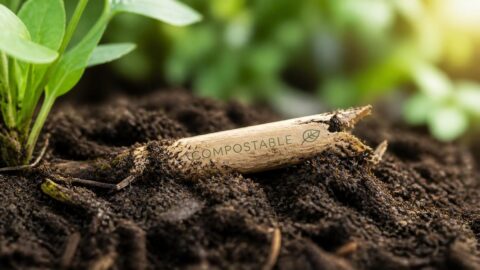
From industrial composting facilities to backyard bins, the true environmental promise of a compostable straw depends entirely on its end-of-life journey.
Every compostable straw’s fate is decided the moment it’s thrown away. There are three possible paths:
Let’s follow the straw down each path.
Day 1–3: Collection and Sorting The straw arrives at a composting facility, typically collected via a municipal green bin or a commercial composting service. Sorting removes contaminants like plastic film or metal.
Day 3–14: Shredding and Mixing Facilities shred compostable materials into smaller pieces and blend them with food scraps, yard waste, and other organic matter to create the right carbon-to-nitrogen ratio.
Day 14–45: Active Composting This is where the magic happens. Industrial facilities maintain temperatures of 55–65°C (131–149°F) — hot enough to accelerate microbial activity and kill pathogens. At these temperatures, PLA and bagasse-based straws break down rapidly as microorganisms consume the material.
Day 45–90: Curing The compost pile cools and matures. By this stage, the straw has typically disintegrated into unrecognizable organic matter.
Day 90–180: Finished Compost The result is nutrient-rich compost, tested for maturity and contaminant-free before being sold or distributed for agricultural and landscaping use.
Bottom line: In an industrial facility, a certified compostable straw reliably breaks down within 45–180 days, per ASTM D6400 and EN 13432 standards.
Home compost bins rarely hit the same sustained high temperatures as industrial facilities — most stay in the 20–40°C (68–104°F) range unless carefully managed. This changes the story significantly.
What helps a straw break down faster at home:
What slows it down:
Realistic home composting timeline: 6–12 months, and only for straws specifically certified as home-compostable. Industrial-only certified straws may persist far longer.
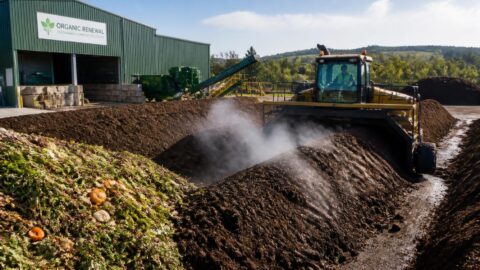
In an industrial composting facility maintaining temperatures between 55–65°C, certified compostable straws reliably break down into finished organic compost within 45 to 180 days.
If a compostable straw ends up in general trash, it’s typically compacted into a landfill with little oxygen and minimal microbial activity. Under these anaerobic conditions, breakdown slows dramatically — and in some cases, organic material trapped in landfills produces methane, a potent greenhouse gas, as it decomposes without oxygen.
This is the single biggest reason composting infrastructure matters as much as the material itself. A compostable straw without a composting pathway loses much of its environmental advantage.
Can I just bury a compostable straw in my garden? It will break down eventually, but slowly and unevenly compared to an active compost pile with proper aeration and moisture.
How do I know if my city has industrial composting? Search your municipality’s waste management website for “organics collection” or “green bin program,” or check with local commercial composting services.
Do compostable straws need oxygen to break down? Yes — most compostable materials rely on aerobic (oxygen-present) microbial activity. Without oxygen, as in landfills, breakdown is much slower and less complete.
A compostable straw’s environmental promise is only fully realized when it reaches the right destination. Industrial composting delivers the fastest, most reliable breakdown. Home composting can work, but only with the right straw certification and conditions. Landfill disposal, while not catastrophic, largely erases the material’s advantage over plastic.
Understanding this journey isn’t just useful trivia — it’s essential for businesses and consumers who want their sustainability efforts to actually deliver results. In our next guide, we’ll walk restaurants and cafés through a practical, step-by-step plan for switching to compostable straws.