Compostable straws are surrounded by more misinformation than almost any other sustainable product category. Some myths make them sound like magic; others dismiss them as pointless greenwashing. Neither extreme is accurate. Let’s separate fact from fiction, myth by myth.
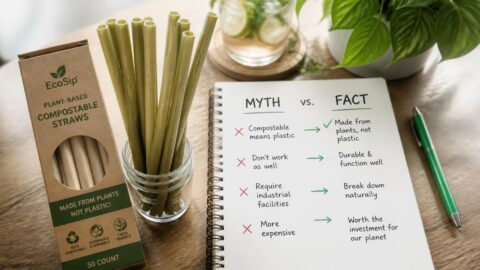
From claims that they dissolve instantly in water to assumptions that they are pointless, compostable straws are surrounded by widespread misconceptions. Let’s separate fact from fiction.
Reality: Standard compostable straws do not dissolve on contact with water. They require specific microbial activity, heat, and time — typically found in a composting environment — to break down. A compostable straw dropped in the ocean will not rapidly disappear; only straws specifically certified for marine biodegradability are designed for that environment, and those are still relatively rare and specialized.
Reality: This one is partly true, which is why it persists. In a landfill, a compostable straw does break down more slowly than it would in an active composting facility, and in low-oxygen conditions it may not fully break down for a long time. However, it’s not accurate to say it’s “just as bad” — compostable materials are made from renewable plant sources rather than petroleum, generally have a lower production carbon footprint, and don’t shed the same persistent microplastics that plastic straws do, even when disposal conditions are imperfect.
Reality: These are marketing words, not certifications. As covered in our certification guide, only third-party verified labels like BPI, TÜV Austria, or EN 13432 confirm genuine compostability. A straw can be labeled “eco-friendly” while containing plastic additives that never fully break down.
Reality: Compostable materials contaminate plastic recycling streams. PLA in particular can be mistaken for PET plastic by sorting equipment, ruining an entire batch of recyclables. Compostable straws belong in a composting stream — or, if unavailable, general trash — never in recycling.
Reality: Early-generation compostable straws in the 2010s often had a reputation for going soggy quickly. Materials and manufacturing have improved significantly since then. Modern bagasse and PLA straws routinely hold up for 1–4 hours in cold drinks — comparable to or better than paper straws, and suitable for most typical drinking timeframes.
Reality: They’re usually more expensive at small order volumes, but the gap narrows significantly at bulk pricing, and some cities’ plastic taxes or fees can partially offset the difference. See our full cost breakdown guide for real numbers.
Reality: Only straws specifically certified as “home compostable” (like TÜV Austria’s OK Compost HOME label) are verified to break down in typical backyard conditions. Many compostable straws are certified only for industrial composting, which reaches higher, more sustained temperatures than a home bin usually achieves.
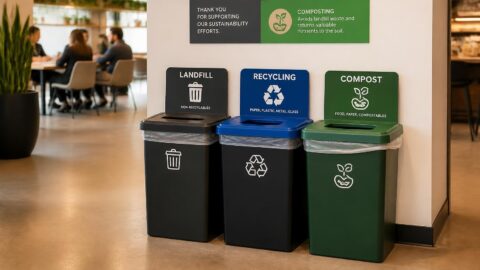
Compostable straws belong strictly in organic composting streams, never in plastic recycling bins where they can contaminate entire batches of recyclable materials.
Reality: This oversimplifies a genuinely complex picture. Compostable straws aren’t a silver bullet, but when paired with proper composting infrastructure, they offer real advantages: renewable sourcing, reduced reliance on fossil fuels, and elimination of persistent microplastic pollution. The environmental benefit is conditional on disposal, not nonexistent.
Reality: As covered in our materials deep dive, compostable straws are made from a range of materials — PLA, sugarcane bagasse, wheat straw, bamboo pulp, and emerging options like PHA — each with different performance characteristics, sourcing stories, and composting requirements. Treating them as one uniform product misses important distinctions relevant to both performance and sustainability claims.
| Myth | Fact |
|---|---|
| Dissolves in water/ocean | Requires composting conditions, not just moisture |
| Same as plastic in a landfill | Slower breakdown, but different sourcing and no persistent microplastics |
| Any “eco” label = compostable | Only certified labels (BPI, TÜV, EN 13432) confirm it |
| Goes in recycling bin | Contaminates recycling; needs composting stream |
| Always flimsy | Modern materials hold up well for typical drink durations |
| Always much pricier than plastic | Gap narrows significantly at bulk volumes |
| Home compostable by default | Only “home compostable” certified straws qualify |
| No real environmental benefit | Real benefit, conditional on proper disposal |
| All made the same way | Multiple distinct materials with different properties |
Believing the overly optimistic myths (like “it’ll dissolve anywhere”) leads to careless disposal and disappointment when a straw doesn’t break down as expected. Believing the overly cynical myths (like “it’s pointless”) discourages businesses and consumers from making a genuinely lower-impact choice. Accurate expectations, grounded in certification and real disposal infrastructure, are what actually make compostable straws effective.
Is there any straw that truly dissolves in water quickly? No standard compostable straw dissolves in water within minutes or hours — that would make it impractical for drinking. Breakdown always requires sustained time and the right biological conditions.
Why do compostable straws get so much criticism online? Much of the criticism stems from early-generation products, unclear labeling standards, and confusion between “biodegradable” and “compostable” — issues this article series addresses directly.
What’s the single most important thing to check before trusting a compostable claim? A recognized third-party certification — BPI, TÜV Austria, or EN 13432 — rather than marketing language alone.
Compostable straws occupy a middle ground that gets lost in online debates: not a miracle cure for plastic pollution, but not a scam either. Understanding the real mechanics — certification, disposal pathways, and material differences — is what separates informed decisions from myth-driven ones.
Next in the series: a practical guide to choosing a trustworthy compostable straw supplier for your business.