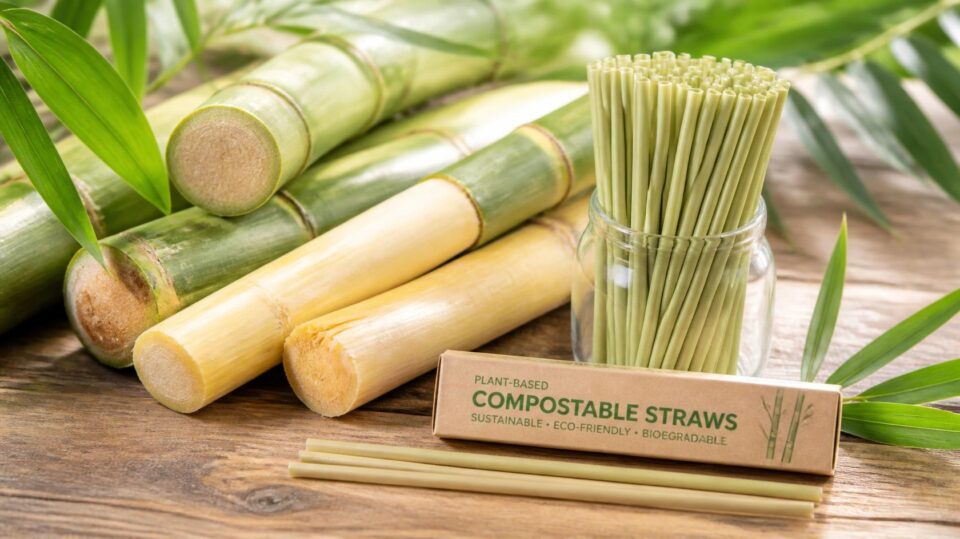
If you’ve shopped for compostable straws in Australia, you may have noticed the code “AS 4736” printed on packaging or product listings. It’s easy to skim past, but this standard is arguably the single most important thing to check before trusting any compostability claim in the Australian market.
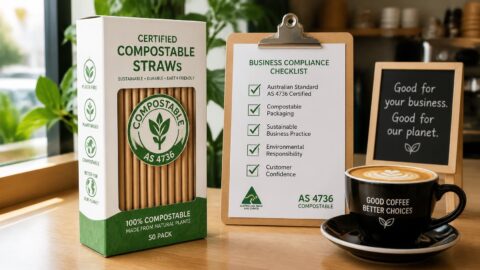
Certified compostable straw packaging showing the AS 4736 certification logo on a café counter
AS 4736 is the Australian Standard specifying requirements for plastics — including bioplastics like PLA — to be considered “biodegradable” and suitable for composting in industrial/commercial composting facilities. It’s the local equivalent of international standards like ASTM D6400 (US) or EN 13432 (EU), tailored to Australian testing and certification bodies.
To meet AS 4736, a product must demonstrate:
Because several Australian states have legislated bans on single-use plastic straws (see our state-by-state guide), businesses face real legal exposure if they supply a straw that claims to be compostable but doesn’t actually meet a recognized standard. Some state legislation, notably Queensland’s, explicitly calls out “greenwashed” plastics — including oxo-degradable plastics that merely fragment rather than genuinely biodegrade — as non-compliant, even if marketed with eco-friendly language.
| Standard | Region | Recognized in Australia? |
|---|---|---|
| AS 4736 | Australia | Yes — the primary local standard |
| EN 13432 | European Union | Yes — widely accepted as equivalent |
| ASTM D6400 | United States | Generally accepted, though AS 4736 is the local reference point |
| AS 5810 | Australia | Yes — the equivalent standard specifically for home composting |
Important distinction: AS 4736 covers industrial/commercial composting. If you want a straw verified for genuine backyard home composting, look specifically for AS 5810 certification instead — the two are not interchangeable, much like the industrial vs. home compostable distinction seen internationally.
Legitimate AS 4736 or AS 5810 certified products are typically verified by recognized certification bodies and carry a traceable certification or licence number. When evaluating a supplier, ask directly for:
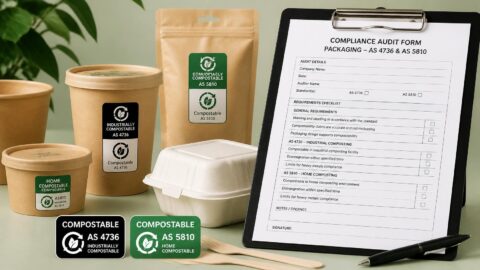
Understanding the vital distinction between AS 4736 (industrial composting) and AS 5810 (home composting) ensures your business matches its straw disposal methods with the correct certification.
In states where plastic straws are banned, using a straw that falsely claims compostability could expose a business to the same non-compliance risk as using a standard plastic straw outright — since the legislation is generally concerned with genuine material performance, not marketing language. Verifying AS 4736 (or an accepted equivalent) certification isn’t just good practice; in many Australian jurisdictions, it’s part of staying on the right side of the law.
Many businesses assume any compostable straw will break down in a standard council green waste or home compost bin. This isn’t necessarily true:
| Certification | Composting Environment | Typical Breakdown Time |
|---|---|---|
| AS 4736 | Industrial/commercial facility | Weeks to a few months |
| AS 5810 | Home compost bin | Several months to a year, under proper conditions |
| No certification | Unverified | Unknown, not guaranteed |
If your business or household relies on a home compost setup rather than a commercial composting service, specifically seek out AS 5810-certified straws rather than assuming AS 4736 certification covers both scenarios.
Is AS 4736 a legal requirement in Australia, or just a recommendation? It’s a recognized technical standard, and while not every state explicitly mandates this exact certification by name, most state bans require genuine compostability or biodegradability that AS 4736 (or an accepted equivalent) is designed to verify.
Can a product be certified under both AS 4736 and international standards like EN 13432? Yes — many manufacturers pursue multiple certifications to sell across both the Australian market and international markets with their own local standards.
Does AS 4736 certification guarantee the straw will break down in any Australian council’s green waste bin? Not necessarily — council green waste (FOGO) programs vary by region in what they accept, so it’s worth checking your specific council’s guidelines even for AS 4736-certified products.
AS 4736 is the backbone of genuine compostability verification in the Australian market, and understanding it — including its distinction from the home-composting-specific AS 5810 — protects both your sustainability credentials and your legal compliance. The next time you’re evaluating compostable straws for your business, treat this certification as the single most important line on the spec sheet.
Coming up next: where Australian businesses can actually source certified compostable straws, from local manufacturers to bulk import options.