Putrajaya, Malaysia’s purpose-built federal administrative capital and seat of the country’s government since the early 2000s, occupies a genuinely distinctive position within the broader paper straws malaysia story. As a city defined almost entirely by government ministries, official buildings, and civil service employment, Putrajaya’s approach to sustainable packaging reflects its unique role as a showcase for national policy implementation.

As Malaysia’s purpose-built federal administrative capital, Putrajaya leverages its unique centralized governance structure to model national sustainability policy, with government-linked F&B outlets leading the consistent adoption of paper straws.
Unlike Malaysia’s organically developed commercial and heritage cities, Putrajaya was deliberately constructed starting in 1995 as a garden city and federal administrative center, hosting the Prime Minister’s Office, numerous federal ministries, and a resident population significantly composed of civil servants and their families. This unique demographic and institutional composition has shaped a business environment where government policy alignment plays an outsized role in shaping F&B practices.
| Institution Type | Straw Policy Approach | Key Driver |
|---|---|---|
| Federal ministry cafeterias | High compliance, policy-aligned | Government sustainability directives |
| Putrajaya Corporation-managed F&B areas | Systematic, centrally coordinated | Municipal governance structure |
| Lakeside restaurants and cafés | High, tourism and event-driven | Visibility to visiting officials/tourists |
| Residential neighborhood eateries | Moderate to high | Government employee customer base |
Unlike other Malaysian cities governed by traditional local councils, Putrajaya is administered by Perbadanan Putrajaya (Putrajaya Corporation), a unique federal statutory body that combines local government functions with the city’s broader role as the administrative capital. This distinctive governance structure has allowed for relatively centralized, consistent implementation of sustainability guidelines across F&B businesses operating within the city, differing from the more fragmented council-by-council approach seen in Malaysia’s other urban centers.
Putrajaya’s numerous federal ministry buildings and government complexes host substantial institutional catering operations serving the city’s large civil service workforce. These institutional cafeterias have generally shown early, consistent paper straw adoption, often aligning with the Malaysian government’s own published sustainability commitments and its broader Roadmap Towards Zero Single-Use Plastics, creating a natural incentive for government-linked catering operations to demonstrate policy alignment.
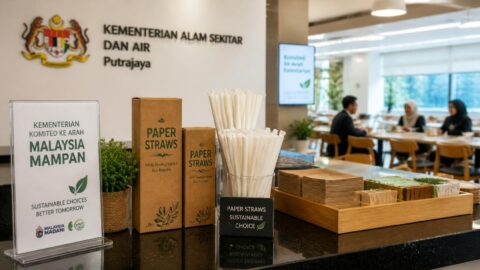
Institutional cafeterias serving Malaysia’s federal civil service workforce in Putrajaya show some of the most consistent paper straw adoption in the country, directly aligning their daily operations with the government’s published sustainability roadmaps.
Beyond its administrative function, Putrajaya has developed a secondary identity as a domestic tourism destination, particularly around Putrajaya Lake, the iconic Putra Mosque, and the city’s extensive parks and botanical gardens. F&B businesses serving this tourism segment, including lakeside restaurants and cafés popular with weekend visitors from Kuala Lumpur and surrounding areas, have generally shown strong paper straw adoption, benefiting from both institutional policy alignment and tourism visibility considerations.
As Malaysia’s administrative capital, Putrajaya regularly hosts official government functions, diplomatic events, and international conferences, each requiring catering services that align with the polished, professional standards expected around government and diplomatic activities. Catering companies serving this segment have generally adopted paper straws and broader sustainable packaging practices consistently, treating compliance as consistent with the professional standards expected in these high-visibility institutional settings.
Putrajaya shares clear similarities with Shah Alam’s systematic, centrally-coordinated approach to sustainability policy, though Putrajaya’s unique status as the literal seat of federal government — rather than simply a planned state capital — creates an even stronger incentive for policy alignment, given the symbolic importance of government institutions visibly modeling the sustainability commitments they promote nationally.
Why does Putrajaya show particularly consistent paper straw adoption? As Malaysia’s federal administrative capital, government-linked institutions and catering operations have strong incentive to align with national sustainability commitments, creating more consistent adoption than typical Malaysian cities.
How is Putrajaya’s governance structure different from other Malaysian cities? Putrajaya is administered by Perbadanan Putrajaya, a unique federal statutory body, rather than a traditional local council, enabling more centralized coordination of policies like single-use plastic reduction.
Do tourists visiting Putrajaya Lake encounter paper straws consistently? Generally yes — lakeside restaurants and cafés serving this domestic tourism segment have shown strong adoption, benefiting from both institutional policy alignment and visitor visibility.
Putrajaya’s paper straw story reflects its unique role as Malaysia’s administrative showcase — a city where government institutions have particular incentive to visibly model the sustainability commitments outlined in national policy documents. As Malaysia continues progressing through its broader Roadmap Towards Zero Single-Use Plastics, expect Putrajaya’s centrally-coordinated, government-aligned approach to remain a distinctive example of how administrative capitals can translate national policy into consistent local implementation.