Paper straws have become the poster child for Europe’s shift away from single-use plastics, but they’ve also attracted plenty of skepticism and misinformation online. Some critics claim paper straws are “just as bad” as plastic, while others treat them as a flawless environmental fix. The truth, as usual, sits somewhere in the middle. Let’s separate myth from fact.
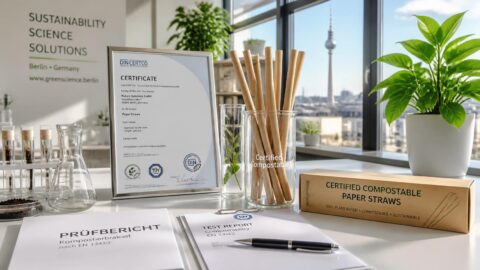
Navigating the debate over paper straw sustainability requires separating internet myth from empirical fact—evaluating genuine compostability, coating chemistry, and the critical difference between manufacturing footprints and multi-century plastic persistence.
Fact: This claim occasionally circulates based on outdated or misapplied studies. In reality, paper straws made from natural kraft pulp typically decompose within weeks to a few months under normal environmental conditions — nowhere close to the 200+ years plastic straws can persist. Confusion sometimes arises from studies involving heavily plastic-coated or wax-coated paper straws, which do decompose slower than uncoated or bio-lacquer coated versions.
Fact: This concern has some real basis — a 2023 Belgian study found trace PFAS-related compounds in some paper straw brands tested, likely from water-resistant coatings. However, not all paper straws use PFAS-containing coatings, and EU manufacturers have increasingly moved toward bio-based, PFAS-free coating alternatives in response to these findings. This is exactly why sourcing from certified, transparent manufacturers matters — asking suppliers directly about their coating chemistry is a reasonable and increasingly common due-diligence step.
Fact: This one is partially true but incomplete. Some life-cycle assessments do show a higher per-unit carbon footprint for paper straw manufacturing due to energy and water use in paper production. However, this comparison usually only accounts for the manufacturing phase — not what happens after disposal. Plastic’s near-permanent persistence in landfills and oceans represents an environmental cost that doesn’t show up in a narrow “production emissions” comparison, but matters enormously over the long term.
Fact: Paper straws that have come into contact with liquid typically can’t go into standard paper recycling streams (due to contamination), but they are compostable — especially fully biodegradable versions with plant-based adhesives. In landfill conditions without oxygen, decomposition is slower than in a proper composting environment, but even then, paper straws don’t persist anywhere near as long as plastic.
Fact: Unverified claims certainly exist in the market, but this doesn’t mean all claims are meaningless. Certifications like EN 13432 provide an actual, testable standard for compostability — a straw either passes controlled decomposition testing within the specified timeframe, or it doesn’t. The real issue isn’t that biodegradability claims are inherently fake, but that consumers and businesses need to check for genuine third-party certification rather than trusting vague labels alone.
| Claim | Verdict |
|---|---|
| Paper straws decompose much faster than plastic | True |
| Some paper straws contain PFAS coatings | Partially true — varies by brand/supplier |
| Paper straw production always has a lower carbon footprint than plastic | False — production footprint can be higher, though full lifecycle favors paper |
| Paper straws are always fully compostable at home | False — depends on certification; some require industrial composting |
| Switching to paper straws meaningfully reduces marine microplastic risk | True |
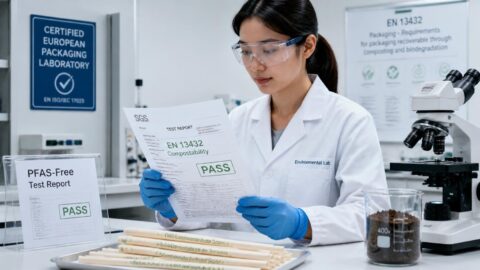
While recent studies have highlighted legitimate concerns regarding chemical coatings in certain brands, verifying third-party certifications and demanding PFAS-free, bio-based coating documentation ensures businesses source safe, genuinely sustainable paper straws.
Should I be worried about PFAS in the paper straws I use daily? It’s a legitimate concern worth asking suppliers about, but not all paper straws contain PFAS — increasingly, manufacturers offer verified PFAS-free options, especially within the EU market.
Is it better to switch to reusable straws instead of paper entirely? For high-frequency personal use, reusable steel or glass straws avoid the sustainability debate around single-use straws altogether — but for commercial, high-turnover settings, paper remains more practical.
Why do some studies seem to contradict each other on paper straws’ environmental impact? Often because they’re measuring different things — manufacturing emissions versus end-of-life decomposition versus marine litter impact are three separate metrics that can produce different conclusions depending on which one a study focuses on.
Are there truly zero-controversy straw options? Not entirely — every material involves trade-offs. Fully biodegradable, PFAS-free, certified paper straws currently represent the most balanced option for single-use scenarios.
Paper straws aren’t a perfect solution, and dismissing legitimate concerns like PFAS coatings would be irresponsible. But the broader claim that paper straws offer no real environmental benefit over plastic doesn’t hold up against the evidence. The smartest approach — for businesses and consumers alike — is asking specific, verifiable questions rather than accepting either blanket praise or blanket skepticism at face value.
