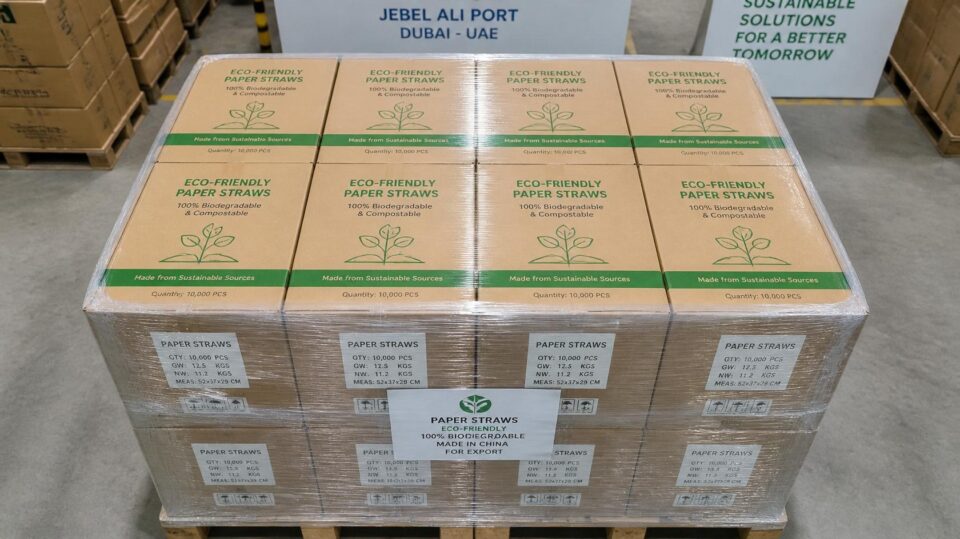
Dubai has built its reputation on being first — first indoor ski slope, first seven-star hotel, first fully autonomous metro. In 2026, the emirate is chasing a quieter but no less significant title: one of the fastest-moving markets in the Middle East for sustainable food-service packaging, and paper straws are at the center of that shift.

As Dubai’s hospitality sector accelerates its transition to sustainable packaging, premium paper straws have become a staple at rooftop lounges and five-star resorts across the emirate.
Dubai’s economy leans heavily on tourism and food service. Between five-star hotel chains along Jumeirah Beach Road, third-wave coffee shops in Al Quoz, and the thousands of restaurants packed into Downtown Dubai and Business Bay, the emirate consumes an enormous volume of single-use drinkware accessories every single day. For years, plastic straws were the default — cheap, durable, and unremarkable.
That default is eroding fast. Municipal-level plastic restrictions across the UAE, combined with genuine consumer pressure from residents and tourists alike, have pushed food-service operators to look for alternatives that don’t compromise on presentation. In a city where dining is often as much about the visual experience as the meal itself, the straw sitting in a mocktail or fresh juice matters more than it would elsewhere.
Bamboo, metal, and glass straws all have a presence in Dubai’s market, but paper straws have emerged as the practical middle ground for high-volume operators. They are single-use (which matters enormously for hygiene-conscious hotel and airline catering), inexpensive to source in bulk, and compostable in a way that aligns with the UAE’s broader waste-diversion targets. For a hotel group running breakfast service for hundreds of guests each morning, a straw that can be thrown away without a second thought — and without guilt — is simply more operationally realistic than a metal straw that needs washing and inventory tracking.
There’s also a branding angle that shouldn’t be underestimated. Boutique hotels and specialty cafes in neighborhoods like City Walk and Al Seef have started treating straw choice as part of their sustainability story, printing logos on kraft-colored paper straws or matching straw color to their interior palette. It’s a small detail, but in a market as visually competitive as Dubai’s F&B scene, small details compound.
For manufacturers and exporters looking at the Dubai market, a few things stand out. First, volume expectations are high — this is not a market for small trial orders. Hotel groups and catering companies operating across multiple properties want suppliers who can commit to consistent, large-scale fulfillment, ideally with regional warehousing or fast freight options through Jebel Ali Port.
Second, quality tolerance is low. Paper straws that go soggy within minutes are a well-known pain point, and Dubai’s F&B operators — many of whom serve extended happy hours and slow-sipping specialty drinks — need straws that hold their structural integrity for 45 minutes or more. Suppliers who can demonstrate durability testing, food-grade certification, and consistent thickness will have a real advantage over those competing purely on price.
Third, customization matters more here than in many other markets. Because Dubai’s hospitality scene is so brand-conscious, the ability to offer custom print runs, unique colorways, or biodegradable wrapping becomes a genuine differentiator rather than a nice-to-have.
Meeting Dubai’s high-volume demand requires dependable, large-scale supply chains, durable manufacturing standards, and fast regional freight options.
Industry watchers expect Dubai’s straw transition to accelerate rather than plateau. As Expo legacy initiatives continue to shape sustainability policy across the emirate, and as more global hotel brands align their Dubai properties with corporate ESG targets set at headquarters level, demand for reliable paper straw supply chains is likely to keep climbing.
For exporters, the takeaway is straightforward: Dubai rewards suppliers who treat paper straws as a quality product rather than a commodity afterthought. Operators here are willing to pay a fair premium for straws that perform well and look good doing it — but they expect consistency, certification, and the ability to scale.
The straw itself is small. The opportunity behind it, in a market moving this quickly, is not.