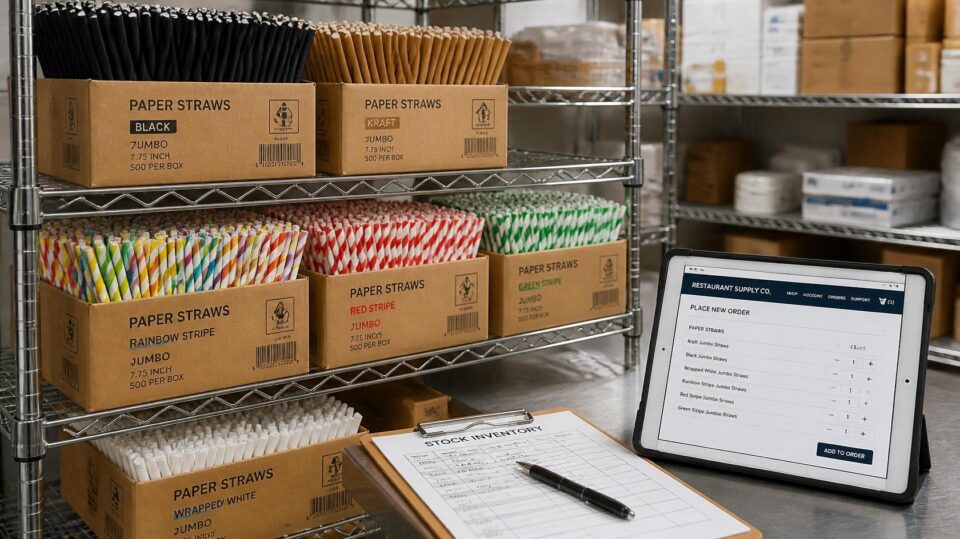
Sourcing paper straws sounds simple until you’re actually comparing suppliers, quantities, and price points. For restaurant owners, café operators, and bar managers, getting this decision right affects everything from monthly supply costs to customer complaints about soggy straws. Here’s a practical, step-by-step buying guide.
Sourcing bulk paper straws for your restaurant requires balancing compliance, volume, and quality to manage supply costs effectively.
Before ordering anything, check whether your location legally restricts plastic straws, requires a “by request only” model, or has no straw-specific rule at all. Roughly a dozen states — including California, New York, Oregon, Washington, Colorado, New Jersey, Rhode Island, Vermont, and Maine — have some form of restriction, while others, like Florida, actively block cities from mandating paper straws. Our full state-by-state straw law guide covers the details, but always verify current local ordinances directly, since city rules frequently go further than state law.
Paper straws are typically sold by:
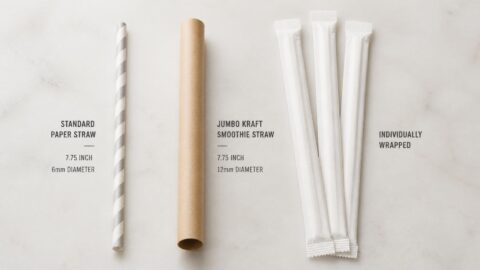
Selecting the correct diameter—from standard for sodas to jumbo for thick shakes—is critical when ordering bulk supplies to avoid operational issues.
High-volume quick-service restaurants can go through tens of thousands of straws per month, while smaller cafés might need only a few thousand. Buying in bulk (cases of 5,000-20,000+ units) meaningfully reduces per-unit cost compared to small retail packs, but ties up storage space and cash flow. A reasonable approach: calculate your average daily drink orders that require a straw, multiply by 30, add a 15-20% buffer for waste and events, and use that as your monthly baseline order.
Domestic US manufacturers like Aardvark and Footprint offer shorter lead times, no tariff exposure, and “Made in USA” positioning that resonates with some customer bases, generally at a higher per-unit cost. Overseas OEM manufacturers, often based in China, typically offer lower unit costs and extensive customization for private-label branding, but require larger minimum order quantities and longer shipping timelines — plan for potential tariff-driven price shifts given the current US-China trade environment. Our manufacturer comparison guide breaks down specific suppliers on both sides.
If your brand markets itself as sustainable, don’t take “eco-friendly” claims at face value. Ask suppliers directly whether their straws have been independently tested for PFAS, and request documentation for any compostability certification claimed (ASTM D6400 is the standard US benchmark). Given the research on PFAS prevalence in paper straws — covered in our PFAS deep-dive — this is an area where supplier transparency varies significantly, and it’s increasingly a point of interest for environmentally conscious customers who may ask.
Paper straw pricing typically follows a tiered bulk-discount model — price per thousand units drops as order volume increases. When comparing quotes, normalize everything to a cost-per-1,000-units basis and factor in:
Request samples and actually test them in your most common drink types — cold soda, iced coffee, a milkshake, hot tea if relevant — and time how long the straw holds up before softening. Soggy-straw complaints are one of the most common customer frustrations with paper straws, and quality varies significantly between manufacturers even at similar price points. This is worth doing even if a supplier’s marketing materials look strong.
How much do bulk paper straws typically cost? Pricing varies significantly by supplier, order volume, and specification, but bulk paper straws are consistently more expensive per unit than bulk plastic straws — factor this into your cost planning, especially at high volume.
What straw diameter do I need for bubble tea? Bubble tea requires a jumbo/wide-bore straw, generally significantly wider than a standard soda straw, to accommodate tapioca pearls without clogging.
Should I buy individually wrapped paper straws? It depends on your hygiene standards and local health code requirements, but be aware that plastic-wrapped paper straws partially undercut the plastic-reduction rationale that led many businesses to switch in the first place.
How do I know if a paper straw supplier is reliable? Request samples, ask for PFAS testing documentation and compostability certifications, and check reviews or references from other restaurants of similar size and order volume.