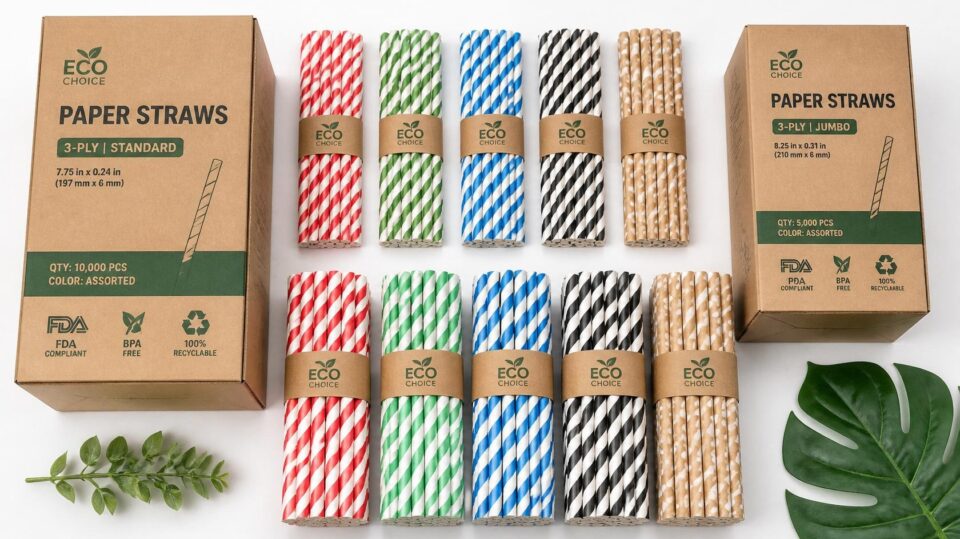
Canberra’s food and beverage demand doesn’t look like other capital cities. Beachfront cafes and tourist strips aren’t driving volume here — government departments, university campuses and a packed conference calendar are. That means “paper straws in Canberra” isn’t really one market. It’s several, each with different ordering patterns, different urgency, and different expectations of a supplier.
Departmental cafeterias and function catering tend to order on a fixed schedule, in large, consistent volumes, often through a formal procurement process that involves quotes, purchase orders and sometimes tender documentation. What matters most here is predictable pricing and stock that doesn’t run short mid-contract — not variety or fast turnaround on small orders. A supplier working with government catering teams needs to be comfortable with longer lead times on the paperwork side, in exchange for larger, more predictable order volumes than a typical cafe would ever place.

Canberra’s unique market of government departments, university campuses, and large-scale event catering requires specialized bulk paper straw supply and reliable scheduling
ANU and Canberra’s other campus food courts see steady day-to-day demand tied to semester patterns, with sharp spikes around orientation week and exam periods when foot traffic through food courts jumps noticeably. Between semesters, demand can drop off significantly, which means campus food service operators benefit from a supplier who understands the academic calendar rather than assuming flat, year-round demand. Ordering too far ahead of a quiet mid-year break wastes storage space; ordering too close to O-Week risks running short exactly when new students are forming their first impressions of campus food options.
Canberra runs a near-constant calendar of national conferences and public events, and catering companies servicing them need to place large, one-off bulk orders with short lead times. This is the part of the Canberra market that looks most like a “normal” hospitality order — just much bigger and more time-sensitive. A caterer confirmed for a three-day conference two weeks out doesn’t have room for a supplier who can’t turn around a large order quickly, which makes reliable stock-on-hand more valuable here than the lowest possible unit price.
Across the CBD, Braddon and Kingston, independent cafes still make up a meaningful part of the city’s food scene, ordering at a scale closer to what you’d see in any other Australian city. These venues don’t need government-scale procurement processes or conference-scale bulk drops — they need straightforward, flexible ordering without being treated as an afterthought by a supplier mostly focused on larger institutional accounts.
The ACT’s plastics ban has applied since 1 July 2022, covering single-use plastic cutlery, drink stirrers, straws, cotton bud sticks, plates, bowls, heavyweight carry bags, expanded polystyrene food and beverage containers, expanded polystyrene loose-fill packaging, expanded polystyrene trays, and plastic microbeads in rinse-off personal care products. It applies equally to a government cafeteria, a university food court and an independent Braddon cafe — there’s no separate rule for institutional buyers, and no grace period based on the size or nature of the organisation involved.
For a small independent cafe, price is often the deciding factor between suppliers. For government catering teams, university food services and conference caterers, reliability tends to matter more — a missed delivery ahead of a major conference or the first week of semester creates a far bigger problem than paying slightly more per carton. Suppliers used to servicing independent cafes sometimes underestimate how much institutional buyers value this kind of predictability over marginal cost savings.
Durable 3-ply, water-resistant paper straws supplied in high-volume cartons ensure consistent performance for large-scale institutional and conference operations
Whether you’re managing catering for a government department, a university campus, a conference, or an independent Canberra cafe, we can supply certified compostable paper straws at the volume and schedule your operation actually needs — without forcing a one-size-fits-all order size onto a market that clearly isn’t one-size-fits-all.
Contact us for wholesale pricing and reliable delivery across the ACT.
Regulations referenced reflect the ACT’s plastics ban current as of July 2026. Always confirm current requirements with the ACT Government before making compliance decisions.