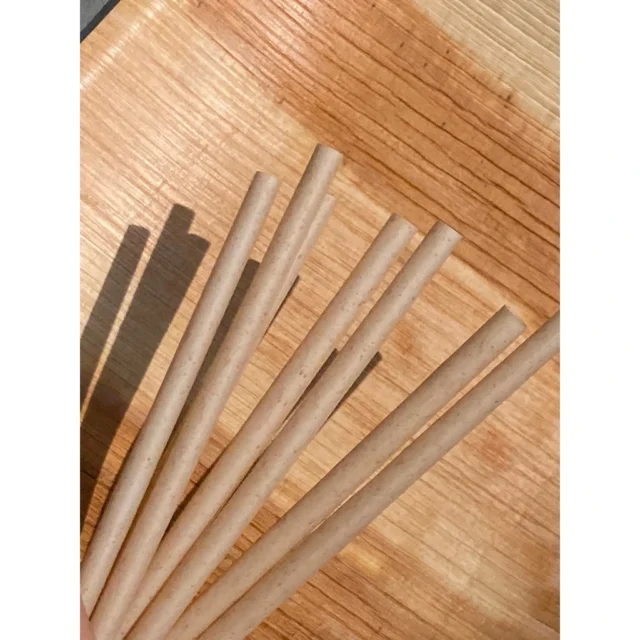
The word “compostable” printed on a straw’s packaging means almost nothing on its own. What matters is whether that claim is backed by an actual certification — a third-party lab test confirming the product breaks down as promised. Here’s how to read the labels like a pro.
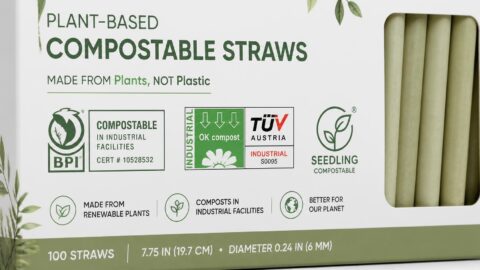
Don’t be misled by vague “eco-friendly” claims. Genuine compostable straws carry trusted third-party certifications like BPI, TÜV Austria, and the Seedling logo, verifying they meet strict industrial composting standards.
In most countries, “compostable” and “biodegradable” aren’t strictly regulated marketing terms unless a certification is attached. That means two straws sitting side by side on a shelf, both labeled “compostable,” could have wildly different real-world outcomes — one might fully break down in 90 days, the other might still be intact after two years. Certification bodies exist to close that gap by requiring standardized lab testing before a product can carry their seal.
This is the underlying technical standard — developed by ASTM International — that defines what “compostable in an industrial facility” actually means in the US. It requires that a product:
Most US compostable straw certifications (like BPI, below) are built on top of the ASTM D6400 standard.
BPI is the certification body that verifies products meet ASTM D6400 (or D6868 for products with fiber components). A BPI-certified straw has been independently lab-tested and approved for disposal in industrial composting facilities across North America. Look for the BPI logo — a green circle with “BPI Compostable” — printed on packaging.
The European equivalent of ASTM D6400, EN 13432 sets requirements for packaging and products to be considered “compostable” under EU law. It covers similar criteria: disintegration, biodegradation, and absence of harmful residue, tested under industrial composting conditions.
TÜV Austria is one of the most recognized certification bodies globally, and it offers two distinct labels that are frequently confused:
The “Seedling” logo is a related mark used across Europe to indicate compliance with EN 13432.
| Certification | Region | Confirms | Home Compostable? |
|---|---|---|---|
| ASTM D6400 | USA (standard) | Industrial composting breakdown | No |
| BPI | USA/Canada (certifying body) | Compliance with ASTM D6400/D6868 | No |
| EN 13432 | European Union | Industrial composting breakdown | No |
| TÜV OK Compost INDUSTRIAL | Global (Austria-based) | Industrial composting breakdown | No |
| TÜV OK Compost HOME | Global (Austria-based) | Home composting breakdown | Yes |
Watch for these warning signs on packaging or product listings:
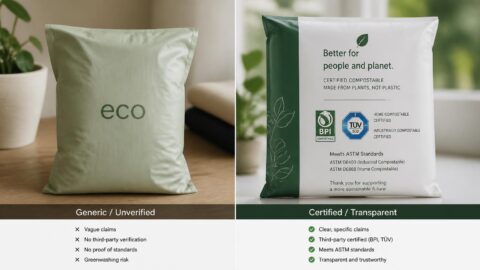
Spotting greenwashing is easier when you know what to look for. A lack of specific certification logos and reliance on vague terms are major red flags that a product’s “compostable” claim may not be independently verified.
Is a product compostable if it just says “made from plant-based materials”? Not necessarily. Being plant-based doesn’t guarantee proper compostability — it’s the certification, not the source material alone, that confirms breakdown performance.
Do all countries require the same certification? No. The US primarily uses BPI/ASTM D6400, while the EU uses EN 13432. TÜV Austria’s certifications are recognized more broadly across international markets, which is why many global suppliers pursue that seal specifically.
Can a straw be both BPI and TÜV certified? Yes — many manufacturers seek multiple certifications to sell across different regional markets with recognized local labeling.
A genuinely compostable straw isn’t defined by clever marketing copy — it’s defined by an independently verified certification. The next time you’re sourcing straws for your business or evaluating a product’s environmental claims, treat the certification logo as the single most important thing on the label.
Coming up next in this series: a practical cost breakdown for businesses budgeting for a full switch to compostable straws.