To really understand whether compostable straws are “worth it,” you have to follow the entire life cycle — not just the moment it ends up in your drink. Here’s the full picture, from farm field to finished compost.
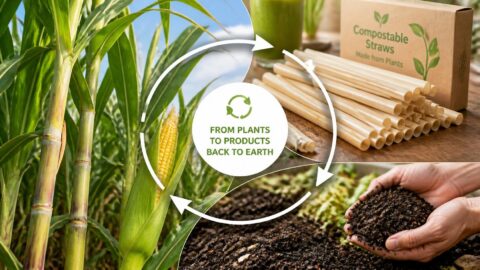
To determine whether compostable straws are truly worth it, we must examine their complete life cycle across all six stages — from raw agricultural field cultivation to returning safely to the soil.
Every compostable straw begins as a crop or agricultural byproduct:
Environmental consideration: Byproduct-based materials (bagasse, wheat straw) generally have a lighter land-use footprint than dedicated-crop materials (corn-based PLA), since they repurpose waste rather than requiring additional farmland.
Raw material becomes straw-ready fiber or resin through:
Environmental consideration: Studies on bioplastic production generally find lower greenhouse gas emissions per unit compared to petroleum-based plastic manufacturing, though the gap varies by material and production method.
Straws are packaged (ideally in compostable or recyclable wrapping, not plastic film) and shipped to distributors, then to end businesses.
Environmental consideration: Shipping distance matters. A straw manufactured overseas and shipped long distances carries a larger transportation footprint than one sourced regionally — a factor worth weighing alongside material choice.
This is the shortest stage by far — typically minutes to a few hours per straw — but it’s the stage most visible to consumers and businesses.
Environmental consideration: The use phase itself has minimal direct environmental impact; the straw’s overall footprint is determined almost entirely by the stages before and after use.
As covered in our earlier composting journey article, disposal outcome varies dramatically:
| Disposal Path | Breakdown Outcome | Climate Consideration |
|---|---|---|
| Industrial composting | 45–180 days, full breakdown | Aerobic process; low methane risk |
| Home composting (certified) | 6–12 months | Aerobic if managed well |
| Landfill | Slow, often incomplete | Anaerobic conditions can generate methane |
| Litter (uncollected) | Slow, environmental persistence | Fragmentation risk, though generally without persistent microplastics |
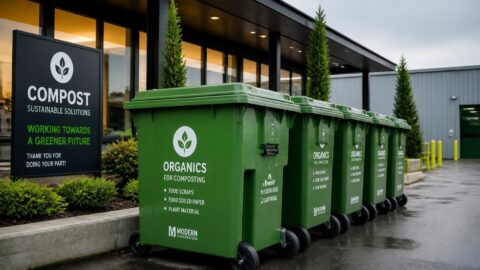
The single greatest variable in a compostable straw’s real-world environmental impact is whether it successfully reaches an active composting facility to complete its biological cycle.
When composting works as intended, the straw completes its cycle by becoming nutrient-rich compost — organic matter that can be returned to agricultural or landscaping soil, closing the loop between farm and field.
| Factor | Compostable Straw | Plastic Straw |
|---|---|---|
| Raw material source | Renewable crops/byproducts | Petroleum (non-renewable) |
| Manufacturing emissions | Generally lower, varies by material | Higher, fossil-fuel dependent |
| Breakdown time (proper disposal) | Weeks to months | Decades to centuries |
| Breakdown time (landfill/litter) | Slower, but no persistent microplastics | Extremely slow, high microplastic risk |
| End-of-life value | Can become usable compost | Becomes permanent waste or microplastic |
| Dependent on infrastructure? | Yes — needs composting access for full benefit | No — but “benefit” here means less positive outcome regardless |
The single biggest variable in a compostable straw’s real-world environmental impact isn’t the material — it’s whether it reaches a composting facility. This is why life-cycle assessments increasingly emphasize:
Do compostable straws have a smaller carbon footprint than plastic overall? Generally yes, across most published life-cycle assessments, though the exact margin depends on the material, manufacturing process, and disposal pathway. Byproduct-based materials like bagasse tend to compare more favorably than dedicated-crop materials like corn-based PLA.
Is it better to reduce straw use altogether rather than switch materials? Reduction is consistently the highest-impact action across nearly all single-use product categories — a straw not used has no life-cycle footprint at all. Compostable materials are the best choice for the straws that are genuinely needed.
What’s the single biggest lever to improve compostable straws’ real-world impact? Expanding access to composting infrastructure. The material innovation already exists; the disposal infrastructure is the bottleneck in most regions.
Compostable straws aren’t a perfect solution, but viewed across their full life cycle — from renewable field to finished compost — they represent a meaningfully lower-impact choice than conventional plastic, provided the disposal infrastructure is in place to let them fulfill their promise. Understanding this complete picture, rather than judging the product at a single stage, is what leads to genuinely informed choices for businesses and consumers alike.
This wraps up our 10-part series on compostable straws — from the fundamentals through certifications, costs, suppliers, and full life-cycle impact. Together, these guides offer a complete picture for anyone looking to make an informed, evidence-based switch away from single-use plastic.