The paper straw industry enters the back half of the 2020s in an unusual position: still growing at double-digit rates by most market forecasts, yet facing more political and scientific scrutiny than at any point since it went mainstream. Here’s where the category appears to be headed.
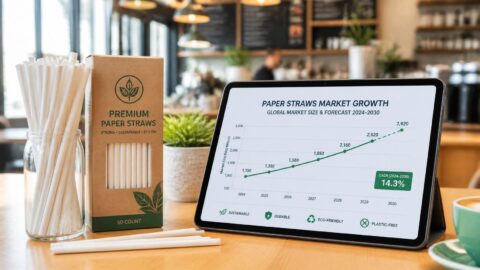
Entering the late 2020s, the US paper straw industry is focusing on PFAS-free innovation, material science, and adapting to a fragmented regulatory landscape.
As awareness of PFAS in paper straws spreads beyond scientific journals and into mainstream consumer consciousness — accelerated, ironically, by the 2025 federal executive order citing PFAS as a reason to abandon paper straws — expect manufacturers to compete more aggressively on chemical transparency. Brands like Roc Paper Straws already market PFAS-free credentials directly; expect this to become a standard label claim across the industry within a few years, alongside third-party testing and certification programs similar to what’s emerged in the food packaging and cosmetics industries for other chemical classes. Businesses sourcing straws should expect “PFAS-tested” to move from a differentiator to a baseline expectation, similar to how “BPA-free” became standard in plastics over the past decade. Our PFAS deep-dive covers the underlying science driving this shift.
Don’t expect the patchwork of state and city straw laws to resolve into a single national standard any time soon. If anything, the trend is toward more divergence: states like California, New York, and Colorado are likely to maintain or tighten existing restrictions, while states like Florida, Texas, and other preemption-law states are likely to further restrict local governments’ ability to mandate paper straws. Multi-state businesses should plan for continued regulatory complexity rather than expecting simplification — our state-by-state guide is worth revisiting periodically as this landscape shifts.
Expect continued R&D investment in straw materials that address paper’s core weaknesses — sogginess and PFAS content — without simply reverting to plastic. This includes improved paperboard formulations with non-fluorinated water-resistant coatings, PHA (marine-biodegradable bioplastic) hybrids like those offered by suppliers such as US-Straws, and continued growth in reusable straw categories (stainless steel, silicone) as consumers and businesses look for options that sidestep the single-use material debate entirely.
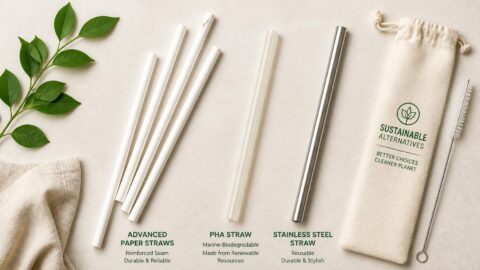
Continued R&D is driving material innovation beyond traditional paper, yielding durable, marine-biodegradable, and chemically transparent alternatives for the American market.
Given ongoing US trade policy volatility and tariff exposure on imported goods, expect continued interest in domestically manufactured paper straws from companies like Aardvark and Footprint, even at a cost premium over overseas OEM production. This dovetails with a broader “Made in USA” positioning trend across foodservice packaging generally, and businesses with tariff-sensitive supply chains may find domestic sourcing increasingly attractive on cost-predictability grounds alone, independent of any sustainability messaging.
While foodservice remains the dominant end-use category for paper straws, market research consistently flags household consumption — driven by direct e-commerce purchases for home use, parties, and children’s drinks — as one of the fastest-growing segments, with some forecasts projecting close to 18% annual growth in that category through the early 2030s. Expect more direct-to-consumer paper straw brands and retail packaging options to emerge as this segment matures.
Straws have become an unusually durable culture-war symbol in American politics, disproportionate to their actual environmental significance. Given that dynamic, expect the paper-vs-plastic straw debate to remain a recurring political talking point through the 2028 election cycle and beyond, with state-level policy continuing to track broader partisan and regional divides rather than settling into consensus based purely on environmental or economic data.
A growing number of businesses — particularly those operating across multiple states with differing straw laws — appear to be sidestepping the paper-vs-plastic debate altogether by defaulting to a “straws by request, in either material” model, letting the customer choose rather than picking a single company-wide policy. This approach reduces both regulatory complexity and the risk of alienating customers strongly opinionated on either side of the debate.
Will paper straws eventually be phased out in the US? Unlikely in the near term. Despite the 2025 federal policy reversal, most market forecasts still show continued growth for the paper straw category through at least 2030, driven primarily by state and local regulation and consumer demand rather than federal policy.
Will PFAS-free paper straws become the industry standard? It’s a plausible trajectory given rising awareness and the political attention the issue has received, though it depends on manufacturers developing effective PFAS-free coatings at competitive cost and scale.
Is the federal government likely to reverse course again on paper straws? That would depend on future election outcomes and administrations; straw policy has already reversed once with a change in presidential administration, so further shifts are plausible given how politically charged the topic has become.
Should my business invest in paper straw infrastructure long-term? Given continued market growth projections and persistent state-level demand, paper straws appear likely to remain a viable long-term category for US foodservice businesses, though staying flexible on sourcing and material options is a reasonable hedge against continued regulatory volatility.