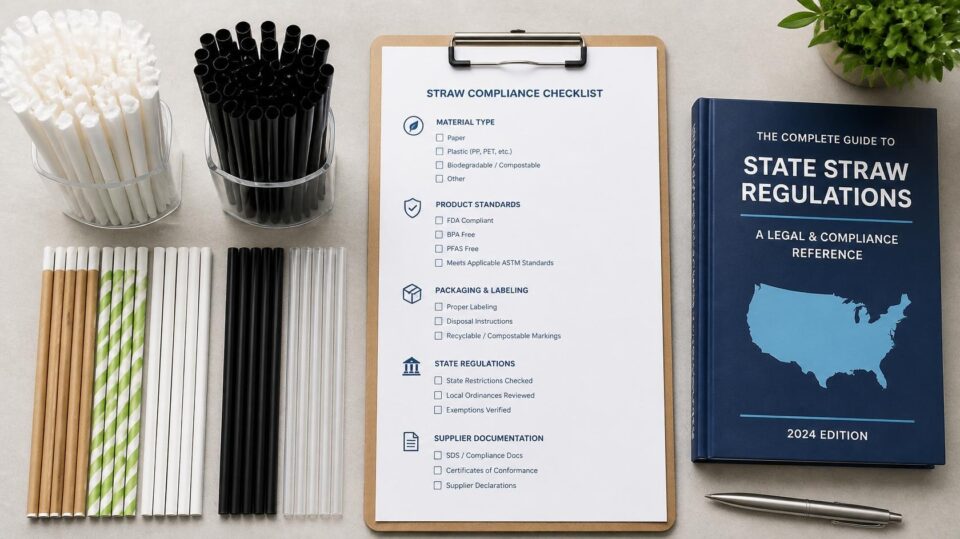
There is no single national law governing straws in the United States. Instead, straw policy is a patchwork of state statutes, city ordinances, and — as of 2025 — a federal executive order that only applies to the federal government itself. If you run a business, travel frequently, or just want to understand why your straw options change from one state to the next, here’s the current landscape.
Navigating straw regulations across the United States requires understanding a complex patchwork of state statutes, local ordinances, and shifting federal policies.
As of 2026, roughly a dozen states restrict single-use plastic straws in at least some settings, almost always through a “by request only” model rather than an outright ban. No state currently bans paper straws. Several states, by contrast, have moved to prevent local governments from mandating paper-only straws at all — a direct reaction to the years of plastic-straw restrictions that preceded them.
California was the first state to act, passing a 2018 law effective January 1, 2019, that prohibits full-service restaurants from automatically providing single-use plastic straws — customers must ask for one. Numerous California cities, including Los Angeles, San Francisco, Santa Monica, Santa Barbara, and San Luis Obispo, layer additional local ordinances on top of the state law.
New York restricts automatic plastic straw distribution in food service establishments, with New York City imposing its own additional rules.
Oregon requires restaurants to provide plastic straws only upon customer request, a rule that took effect in 2019, with Portland enforcing a similar local ordinance.
Washington enacted a statewide restriction following Seattle’s landmark 2018 ban — the first major US city to prohibit plastic straws outright in food service.
New Jersey and Rhode Island both passed “by request only” straw laws in 2021 as part of broader single-use plastic legislation.
Vermont, Maine, and Delaware have statewide restrictions or laws empowering municipalities to regulate plastic straws.
Colorado goes further than most, having passed the Plastic Pollution Reduction Act (HB 21-1162), which restricts businesses from automatically distributing single-use plastic straws and stirrers as part of a wider single-use plastics law.
Connecticut has its own single-use plastic and polystyrene restrictions that touch on straws as part of a broader foodservice packaging framework.
Not every jurisdiction is tightening straw rules — some are actively loosening them. Florida has advanced legislation aimed at preventing local governments from mandating paper-only straws, joining a group of states, including Texas, Ohio, Arizona, Idaho, Indiana, and Missouri, that use preemption laws to block cities from enacting their own plastic restrictions altogether, whether on straws, bags, or foam containers.
This preemption trend has accelerated since the 2025 federal executive order shifted the political tone in Washington, and it’s worth watching closely if you operate a multi-state business, since a straw policy that’s mandatory in one state could become effectively unenforceable — or even legally blocked — in a neighboring one.
From request-only mandates in coastal states to preemption laws in the South and Midwest, business compliance varies significantly by jurisdiction.
Even in states without a statewide restriction, individual cities have enacted their own straw ordinances, including Seattle (the first major US city ban, 2018), plus local rules in parts of Hawaii, New Mexico, Georgia (Atlanta and South Fulton), and Illinois (which passed its own Plastic Straw Ban Act at the state level, prohibiting restaurants and bars from providing single-use plastic straws). Always check municipal code in addition to state law — city rules are frequently stricter.
Executive Order 14208, signed by President Trump in February 2025, directs federal agencies to stop purchasing and providing paper straws in federal buildings and calls for a national strategy discouraging paper straw use more broadly. Crucially, this order governs federal procurement and federal facilities — it does not preempt or overturn state and city straw laws. A restaurant in Santa Monica is still bound by California’s request-only rule regardless of federal policy. Read our full breakdown of the executive order and what it changes.
If you operate restaurants, cafés, or retail locations across several states, the practical reality in 2026 is that you’re managing at least three categories of straw policy simultaneously: states that restrict plastic straws, states that preempt local restrictions entirely, and states with no specific rule either way. Many national chains simply standardize on paper or request-only policies everywhere to reduce operational complexity, even where not legally required — though rising material costs and the PFAS controversy (covered in our dedicated PFAS article) are prompting some brands to revisit that default.
Is there a federal ban on plastic straws in the US? No. There has never been a federal ban on plastic straws for private businesses. The only federal-level action is the 2025 executive order limiting paper straw use within the federal government itself.
Which state was first to restrict plastic straws? California, effective January 1, 2019, requiring full-service restaurants to provide plastic straws only upon request.
Can a city ban plastic straws if the state doesn’t? It depends on the state. States without preemption laws generally allow cities to pass their own, often stricter, ordinances. States like Florida and Texas have preemption laws that block or limit this.
Do any states ban paper straws? No US state currently bans paper straws. Some states have restricted local governments’ ability to mandate paper straws exclusively, which is different from banning paper straws themselves.