The paper straw industry has quietly become one of the fastest-growing categories in disposable foodservice packaging, and the United States is at the center of it. Here’s what the data says about market size, growth rate, and what’s fueling the expansion — plus the headwinds now working against it.
Driven by strong regulatory pressure and foodservice adoption, the US paper straw market continues to scale as a key segment of sustainable packaging.
Estimates vary by research firm because methodologies differ, but the direction is unmistakable. Several major industry reports peg the global paper straw market between roughly $1.7 billion and $3.2 billion in 2026, with forecasts reaching anywhere from $6 billion to $9 billion or more by the early 2030s, translating into compound annual growth rates commonly cited between 13% and 19%. One widely referenced estimate puts the US paper straw market specifically on track to reach over $700 million by the early 2030s.
North America consistently ranks as either the largest or second-largest regional market, holding an estimated 34-38% global market share in recent reports — a reflection of how aggressively US foodservice chains, retailers, and grocery stores adopted paper straws over the past six years.
Regulatory pressure. Even without a federal ban, roughly a dozen US states now restrict automatic plastic straw distribution, and hundreds of individual cities layer stricter ordinances on top. Businesses operating across multiple states often standardize on paper straws nationwide simply to avoid managing different straw policies location by location.
Foodservice expansion. Restaurants, cafés, quick-service chains, and beverage concepts like bubble tea shops account for the large majority of paper straw demand — one report puts foodservice at nearly 78% of total application share. As the US food and beverage industry grows, so does straw demand.
Corporate sustainability commitments. Many national restaurant and retail brands adopted paper straws as part of broader ESG and packaging pledges, independent of local law, which has kept demand elevated even in states without straw restrictions.
E-commerce and household adoption. Household use is one of the fastest-growing segments, with some reports projecting nearly 18% annual growth in that category alone, as consumers buy paper straws directly for home use, parties, and children’s drinks.
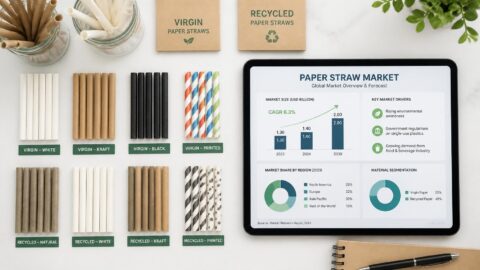
Foodservice expansion and multi-state compliance standardization remain the primary catalysts propelling double-digit growth across North American markets.
The 2025 federal policy reversal. Executive Order 14208 directed federal agencies to stop purchasing paper straws, which — while not a broad market-mover on its own — signaled a shift in political tone that has emboldened straw-friendly plastic legislation in several states.
State-level pushback. States such as Florida have pursued legislation preventing local governments from mandating paper-only straws, creating friction against further expansion in some regions.
Cost sensitivity. Paper straws generally cost more per unit to manufacture than plastic straws, which matters enormously to high-volume foodservice operators watching margins amid broader cost inflation.
The PFAS findings. Research showing that a majority of paper straws tested positive for PFAS “forever chemicals” has complicated the industry’s core sustainability pitch, prompting some environmentally conscious buyers to look at alternatives like stainless steel or silicone instead.
Industry reports typically break the market down by:
For foodservice operators, the growth data suggests paper straws aren’t going away as a category even amid political controversy — but buyers should expect continued price competition among suppliers as more manufacturers enter the space, alongside growing customer interest in PFAS-free and domestically produced options. For businesses evaluating suppliers, our guide to the top paper straw manufacturers serving the US market breaks down the major players by capacity, certification, and sourcing model.
Is the paper straw market still growing in 2026? Yes. Despite the federal policy reversal, most industry forecasts still show double-digit annual growth through at least 2030, driven primarily by state and local regulations and foodservice demand rather than federal policy.
Which region has the largest paper straw market? North America, driven largely by the United States, holds one of the largest regional shares globally, generally estimated between roughly 35% and 38%.
Why do market size estimates vary so much between reports? Different research firms use different methodologies, base years, and scope definitions (some include stirrers or plant-based straws broadly, others focus narrowly on paper). Treat all figures as directional estimates rather than precise counts.