Baguio City, perched at roughly 1,500 meters above sea level in the Cordillera mountains, holds a genuinely unique position within the Philippines’ paper straws philippines landscape — the country’s only major city with a consistently cool, temperate-adjacent climate, creating distinctly different practical conditions for paper straw storage and performance than found almost anywhere else in the tropical archipelago.

As the Philippines’ only major city with a consistently cool, temperate climate, Baguio enjoys a natural advantage in the shift to paper straws—where lower humidity and cooler temperatures mean fewer storage-related softening issues compared to the sweltering tropical lowlands.
Known nationally as the “Summer Capital of the Philippines” for its refreshingly cool temperatures compared to the sweltering heat of the lowlands, Baguio’s climate creates meaningfully different humidity and temperature conditions for paper straw storage than the high-humidity, consistently hot conditions found in most other Philippine cities covered in this series.
| Factor | Typical Philippine Lowland City | Baguio |
|---|---|---|
| Average temperature | 27-32°C year-round | 15-23°C year-round |
| Humidity levels | Consistently high | Generally lower, more variable |
| Straw pre-use degradation risk | Higher, requires careful sealed storage | Lower, more forgiving storage conditions |
| Seasonal variation | Minimal | More pronounced, including a distinct cool season |
Baguio’s cooler, less consistently humid climate creates measurably more forgiving storage conditions for paper straws compared to lowland Philippine cities, where businesses often report needing especially careful sealed storage and frequent inventory turnover to prevent premature softening. This climate advantage has occasionally been cited by Baguio-based F&B businesses as one factor making paper straws a more practically straightforward transition than in hotter, more humid parts of the country.
Baguio has developed a notable specialty coffee and café culture, particularly along and near Session Road, drawing both local students and tourists seeking the city’s cooler climate and mountain scenery. This café-forward business identity has generally supported strong, design-conscious paper straw adoption similar to patterns seen in other Philippine cities with prominent specialty coffee scenes.
The nearby strawberry farms of La Trinidad, a major agricultural tourism draw for visitors to the Baguio area, host numerous small food and beverage stalls serving fresh strawberry-based drinks and treats to tourists. These agriculturally-linked tourism vendors have shown gradually increasing paper straw adoption, influenced by both the broader tourism visibility of the area and growing environmental consciousness tied to the region’s agricultural and natural heritage.
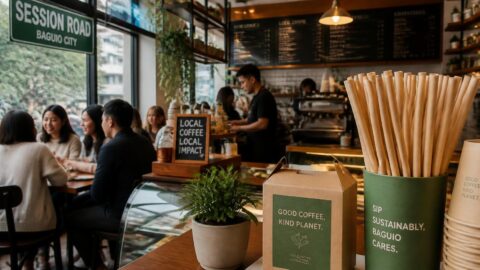
Baguio’s thriving specialty café culture, particularly along Session Road, has been a key driver in the city’s transition, where design-conscious business owners find that the city’s cooler climate makes high-quality paper straws both practical and easy to maintain.
As home to numerous universities, including the University of the Philippines Baguio and Saint Louis University, Baguio carries a substantial student population that has shaped local café and food stall culture toward younger, more sustainability-conscious consumer expectations, similar to university-dense patterns observed in other Philippine cities’ paper straw adoption stories.
Baguio’s historic public market, a significant local commerce hub, hosts numerous traditional food and beverage vendors that have generally followed more typical, gradual Philippine adoption patterns similar to public markets in other Philippine cities, showing that climate advantages alone haven’t fully overridden the cost-sensitivity factors that shape adoption timelines among smaller, traditional vendors nationwide.
Unlike Boracay’s crisis-driven, mandatory compliance model or Cebu’s marine-tourism-linked adoption, Baguio’s paper straw story reflects a more climate-and-demographics-driven pattern — one shaped by the practical advantages of a cooler storage environment and a strong student and café-culture consumer base, rather than direct environmental crisis or ocean conservation messaging specifically.
Does Baguio’s cool climate make paper straws easier to use than in other Philippine cities? Generally yes — the city’s lower humidity and cooler temperatures create more forgiving storage conditions for paper straws compared to the consistently hot, humid conditions found in most other Philippine cities.
Are Baguio’s cafés known for paper straw adoption? Yes — the city’s prominent specialty coffee and café culture, particularly along Session Road, has generally shown strong, design-conscious paper straw adoption.
Does Baguio’s public market show the same adoption pace as its cafés? Not entirely — traditional vendors in Baguio’s public market generally follow more typical, gradual Philippine adoption patterns similar to public markets elsewhere in the country.
Baguio’s paper straw story offers a distinctive reminder that environmental adoption isn’t shaped by policy and culture alone — basic physical geography and climate can meaningfully influence how practical a given sustainability transition actually is on the ground. As the Philippines’ only major cool-climate city, Baguio’s relatively favorable storage conditions for paper products represent a genuine, if often overlooked, natural advantage within the country’s broader, climate-challenged transition away from plastic straws.