Few destinations in the Philippines have a paper straw story as directly tied to a single defining event as Boracay. The island’s dramatic 2018 closure for environmental rehabilitation — a six-month shutdown ordered directly by the national government following years of overdevelopment and environmental degradation — fundamentally reset expectations around sustainability across the island’s entire tourism economy, making Boracay a uniquely instructive case within the Philippines’ broader paper straws philippines landscape.

Following its dramatic 2018 environmental rehabilitation, Boracay established some of the Philippines’ strictest sustainability standards for tourism businesses, making the switch to compostable alternatives like paper straws a core condition for operating on the island.
In April 2018, President Rodrigo Duterte ordered Boracay’s complete closure to tourists, citing severe environmental degradation from years of unchecked development, inadequate sewage infrastructure, and pollution threatening the island’s famous white sand beaches. The six-month rehabilitation period that followed included a comprehensive review of business practices across the island, with environmental compliance — including single-use plastic reduction — becoming a central condition for businesses to reopen.
| Requirement Category | Standard Applied |
|---|---|
| Single-use plastic reduction | Strict requirements for reopening businesses |
| Wastewater treatment compliance | Mandatory connection to proper sewage systems |
| Beach easement clearance | Removal of structures encroaching on protected zones |
| Environmental compliance certificates | Required for continued business operation |
| Ongoing monitoring | Regular inspections by DENR and local authorities |
Unlike cities where paper straw adoption remains largely voluntary or loosely enforced, Boracay’s businesses emerged from the 2018 rehabilitation understanding that environmental compliance, including plastic reduction measures like paper straws, was directly tied to their continued license to operate. This created a fundamentally different enforcement dynamic than seen almost anywhere else in the Philippines — one where non-compliance carried genuine existential business risk rather than a modest fine.
The Department of Environment and Natural Resources (DENR), which played a central role in coordinating Boracay’s rehabilitation, has maintained ongoing monitoring presence on the island well beyond the initial 2018 closure, creating sustained institutional pressure for continued environmental compliance that most other Philippine tourist destinations don’t experience at the same intensity or consistency.
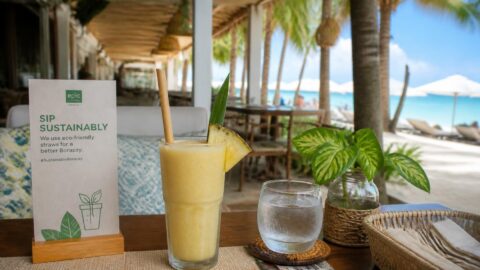
Businesses operating along Boracay’s stations have integrated sustainable practices, including the consistent use of paper straws, into their core operations as part of the island’s ongoing commitment to environmental management and license compliance.
Boracay’s international visitor base, drawn from markets across Asia, Australia, Europe, and North America, generally arrives with strong expectations around environmental responsibility, particularly given the island’s well-publicized rehabilitation story that received significant international media coverage. This global visibility has created additional reputational pressure for businesses to maintain visible sustainability practices, including consistent paper straw use, well beyond the letter of any specific local ordinance.
Boracay’s rehabilitation also introduced broader carrying capacity management for the island, limiting total visitor numbers to reduce environmental strain — a systemic approach to sustainable tourism that extends well beyond straws alone but reinforces the island’s overall commitment to environmental management as a core part of its tourism brand identity, rather than a superficial marketing add-on.
While Cebu’s paper straw adoption is driven primarily by voluntary tourism industry standards and conservation-conscious dive operators, Boracay’s transition reflects a fundamentally different mechanism — direct, government-mandated environmental compliance tied to business licensing itself, making it one of the few places in the Philippines where paper straw adoption effectively became compulsory rather than voluntary.
Why did Boracay close in 2018? The Philippine government ordered a six-month closure due to severe environmental degradation, including pollution and inadequate sewage infrastructure, threatening the island’s ecosystem.
Are paper straws mandatory for businesses in Boracay? While not always codified as a single explicit straw-specific law, environmental compliance requirements tied to business licensing following the 2018 rehabilitation have made sustainable packaging practices, including paper straws, an effectively necessary standard for continued operation.
How does Boracay’s enforcement differ from other Philippine tourist destinations? The direct link between environmental compliance and business licensing, reinforced by ongoing DENR monitoring, creates significantly stronger enforcement consistency than typical local ordinances elsewhere in the country.
Boracay’s paper straw story stands apart within the Philippines precisely because it wasn’t driven by gradual policy evolution, but by a genuine environmental crisis that forced immediate, comprehensive change. As the island continues balancing tourism revenue with the hard-won environmental standards established through its rehabilitation, Boracay offers a distinctive, if extreme, example of how quickly sustainability practices can become deeply embedded when business survival itself depends on compliance.