Cebu occupies a genuinely distinctive position within the Philippines’ paper straws philippines landscape — a province and metropolitan area that combines world-renowned diving and marine tourism with one of the country’s most established export manufacturing bases, creating overlapping pressures rarely found together in a single Philippine location.

In Cebu, a dual identity as an internationally renowned diving tourism hotspot and a sophisticated export manufacturing hub creates a uniquely reinforcing environment where conservation messaging and high operational standards drive consistent adoption of paper straws.
Metro Cebu functions simultaneously as a major international tourism gateway, drawing divers and beach tourists to destinations like Moalboal and Mactan Island, and as a significant manufacturing and export hub, particularly known for furniture, handicrafts, and light industry. This dual identity has created two distinct, sometimes overlapping, drivers of sustainability adoption across the region’s F&B sector.
| Sector | Primary Driver | Straw Adoption Pattern |
|---|---|---|
| Mactan Island resorts | International tourist expectations | High, consistent |
| Moalboal dive shops and cafés | Eco-tourist customer base | High, conservation-linked |
| Cebu City malls (Ayala, SM) | Mall-wide sustainability policies | High |
| Export manufacturing zone cafeterias | Corporate/employer-driven | Moderate to high |
| Traditional lechon and carinderia stalls | Cost sensitivity | Slower, gradual |
Cebu’s status as one of the world’s premier diving destinations, particularly around whale shark tourism in Oslob and coral reef diving near Moalboal, has created a customer base of environmentally engaged tourists who often specifically notice and value visible sustainability practices, including paper straw use, at dive resorts and nearby F&B establishments. Several dive operators have integrated broader marine conservation messaging into their business branding, making sustainable packaging a natural extension of their core tourism offering.
Cebu’s established furniture and handicraft export industry, built around decades of experience meeting international buyer sustainability and quality standards, has created a broader business culture within the province more accustomed to navigating certification requirements and export-oriented documentation than many other Philippine regions. Some industry observers suggest this export-manufacturing sophistication has indirectly influenced how seriously local F&B businesses approach their own sustainability compliance, given a shared regional business culture familiar with meeting external standards.
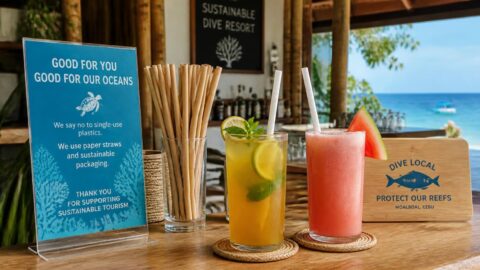
Dive resorts across Cebu’s coastal areas are at the forefront of the paper straw transition, directly linking their packaging choices to the protection of the coral reef ecosystems that draw environmentally engaged international tourists to the province.
Mactan Island, home to Cebu’s international airport and a dense concentration of beach resorts, sees particularly consistent paper straw adoption among its hospitality sector, driven by direct exposure to international tourists — many arriving from markets with well-established plastic reduction expectations — and resort management companies increasingly incorporating sustainability commitments into broader guest experience branding.
Given Cebu’s established expertise in working with natural materials like rattan, bamboo, and other fibers for its furniture export industry, some local entrepreneurs have expressed interest in exploring whether similar material handling expertise could eventually extend into compostable packaging production, though this remains a largely unrealized potential rather than an established local manufacturing presence.
Why does Cebu show relatively strong paper straw adoption compared to other Philippine provinces? Its combination of internationally-facing tourism, particularly diving and marine tourism, along with an established export manufacturing culture familiar with international standards, has created multiple reinforcing drivers for sustainability adoption.
Do Cebu’s dive tourism businesses specifically emphasize paper straws? Many do, often as part of broader marine conservation messaging that aligns naturally with their core diving and reef tourism business.
Is there local paper straw manufacturing in Cebu? Not at significant scale currently, though the province’s established expertise with natural fiber materials for furniture export creates theoretical potential that remains largely unexplored commercially.
As both Cebu’s tourism and manufacturing sectors continue growing, expect the province’s distinctive combination of conservation-conscious dive operators and export-standard-savvy manufacturers to keep reinforcing each other, potentially positioning Cebu as an increasingly influential model for how tourism and industry can jointly drive sustainability adoption elsewhere in the Philippines.
Cebu’s paper straw story illustrates how genuinely different economic drivers — marine conservation tourism and export manufacturing sophistication — can combine to create a business environment more consistently receptive to sustainability practices than might be expected from either factor alone. As Cebu continues developing both its tourism and manufacturing sectors, expect this dual-driver dynamic to keep distinguishing the province’s approach to paper straws from more single-industry-dependent regions elsewhere in the Philippines.