Quezon City, the most populous city in Metro Manila and a former Philippine national capital, occupies a genuinely significant position within the country’s paper straws philippines landscape — a place where a massive university student population, extensive government institution presence, and one of Metro Manila’s more consistently enforced local ordinances have combined to create relatively strong, broad-based paper straw adoption.

Quezon City’s massive, sustainability-minded student population and dense concentration of government institutions have propelled it to the forefront of the paper straw transition in Metro Manila, where institutional and consumer-driven demand reinforce strong local ordinance enforcement.
Quezon City has been recognized as among the more proactive Metro Manila cities in passing and enforcing local ordinances restricting single-use plastics, including plastic straws, reflecting the city’s broader institutional capacity as the country’s largest and one of its most administratively developed local government units.
| Driver | Influence on Straw Adoption |
|---|---|
| University Belt extension (UP Diliman area) | Large, sustainability-conscious student population |
| Government center institutions | Numerous national agency offices, procurement standards |
| Local ordinance enforcement | Relatively consistent compared to other Metro Manila cities |
| Shopping mall density (SM North, Trinoma) | Mall-wide sustainability policies |
UP Diliman, one of the country’s most prestigious universities and home to a large, environmentally engaged student population, has created a substantial customer base within Quezon City with above-average awareness of and demand for sustainable packaging practices. Businesses in areas like Katipunan Avenue and the broader university belt extension have generally shown faster, more consistent paper straw adoption than typical Philippine commercial districts, influenced significantly by this student consumer base’s preferences.
As home to numerous national government agency offices, including significant portions of the Philippine government’s administrative apparatus that operate from Quezon City rather than Manila proper, the city hosts substantial institutional catering demand where government procurement considerations, similar to patterns seen in other countries’ administrative capitals, have created additional pressure for sustainable packaging compliance among vendors serving these government offices.
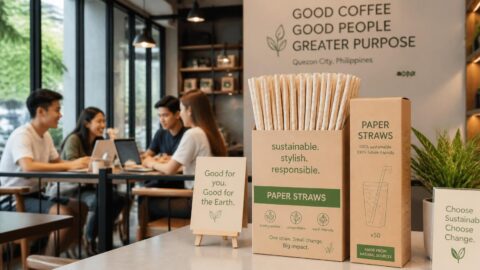
Businesses across the University of the Philippines Diliman-influenced areas and nearby administrative districts consistently adopt paper straws, driven by the combined pressure of student consumer demand, government-aligned procurement practices, and relatively proactive city ordinance enforcement.
As the Philippines’ most populous city, Quezon City’s sheer scale creates both opportunities and challenges for consistent straw ordinance enforcement — while formal, prominent commercial districts show strong compliance, the city’s vast residential areas and countless smaller neighborhood establishments present genuine enforcement capacity challenges similar to those seen in Manila’s own dense informal economy, despite QC’s generally stronger institutional reputation.
Quezon City’s massive population has made it host to some of the Philippines’ highest concentrations of fast food and chain restaurant locations, businesses that generally align quickly with straw ordinances given their typically centralized corporate sustainability policies and greater capacity to absorb compliance costs compared to smaller independent establishments.
While Manila’s paper straw story is shaped significantly by its massive informal vending economy and dense historic commercial districts, Quezon City’s more institutionally-driven adoption — anchored by universities and government offices — has generally produced somewhat more consistent enforcement outcomes across its formal commercial sector, even as both cities share similar challenges reaching their extensive informal and residential-neighborhood food economies.
Does Quezon City have a specific local ordinance banning plastic straws? Yes — Quezon City has been recognized among Metro Manila’s more proactive cities in establishing and enforcing local ordinances restricting single-use plastics, including straws.
How has UP Diliman influenced paper straw adoption in the area? The university’s large, environmentally-conscious student population has created strong consumer demand for sustainable packaging among nearby businesses, accelerating adoption beyond typical Metro Manila patterns.
Are government offices in Quezon City required to use paper straws in their cafeterias? While not always codified as an explicit straw-specific rule, government procurement and institutional catering standards have generally created pressure toward sustainable packaging compliance among vendors serving these offices.
Quezon City’s paper straw story reflects how institutional density — universities, government offices, and major shopping centers — can combine to produce relatively strong, broad-based sustainability adoption even within a massive, demographically diverse city. As the Philippines’ most populous local government unit, Quezon City’s relatively proactive ordinance enforcement offers other large Philippine cities a useful reference point for how administrative capacity and institutional presence can translate into more consistent environmental policy outcomes.