Few disposable products generate as much genuine disagreement as the paper-vs-plastic straw debate. Both sides have real evidence behind them, and the honest answer is that neither material wins on every measure. Here’s a clear-eyed, category-by-category comparison based on the current research and market data.
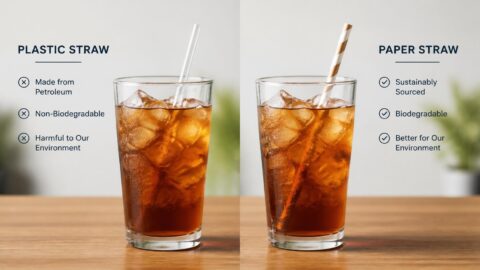
Comparing paper and plastic straws requires balancing environmental impact, cost, manufacturing footprint, and everyday user experience.
| Category | Paper Straws | Plastic Straws |
| Manufacturing cost | Higher | Lower |
| Biodegradation time | Weeks to months | Up to ~300 years |
| PFAS detection rate* | ~90% of brands tested | ~75% of brands tested |
| Durability in drink | Softens after 15-30 min | Stays rigid |
| Marine litter impact | Low | High (major ocean pollutant) |
| Recyclability | Generally not recyclable (food-contaminated) | Rarely recycled in practice |
| US regulatory status | Preferred/default in ~12 states | Restricted to “by request” in ~12 states |
*Based on the 2023 University of Antwerp study of 39 straw brands; see our PFAS deep-dive for full context.
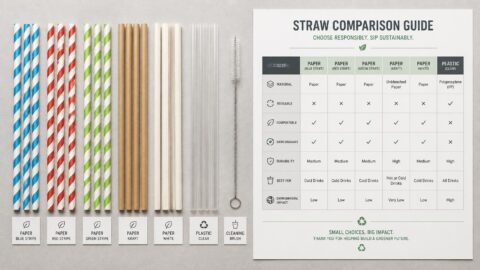
While plastic straws excel in cost and durability, paper straws offer a decisive advantage in biodegradation and reducing long-term marine pollution.
This is where plastic straws lose most decisively. Plastic straws are made from polypropylene, a petroleum-derived plastic that does not meaningfully biodegrade — estimates commonly cited put their environmental breakdown time at roughly 200 to 300 years. They’re also lightweight enough to escape waste management systems easily, making them one of the most commonly identified items in beach cleanups and a well-documented hazard to marine life. Paper straws, by contrast, are compostable and typically break down within weeks in the right conditions, substantially reducing the risk of long-term ocean pollution.
That said, paper straws aren’t environmentally perfect either. Manufacturing paper straws generally requires more energy and water than plastic straw production, and if PFAS coatings are involved, the resulting straws can shed persistent chemicals into compost, landfill, or waterways at end of life — see our PFAS research breakdown for the details.
Contrary to popular assumption, “paper” doesn’t automatically mean “chemical-free.” Multiple studies have found PFAS forever chemicals in a majority of paper straw brands tested, generally at higher rates and concentrations than plastic straws — though plastic straws are not PFAS-free either, with PFAS detected in a majority of plastic brands tested in the same research. Neither material has been shown to pose an acute health risk from typical, occasional use; the concern for both is long-term, cumulative chemical exposure.
Plastic straws are, and remain, cheaper to manufacture — a fact acknowledged even in critical government assessments like the 2025 federal executive order on paper straws. For high-volume restaurants and quick-service chains buying straws by the millions, the per-unit cost difference adds up meaningfully over a year. This cost gap is one reason some businesses have been quietly relieved by the political and regulatory softening around plastic straws, even as environmentally-focused customers push in the opposite direction.
This is the most subjective category, but it’s also the one most frequently cited in consumer complaints and in political criticism of paper straws. Paper straws can soften, wrinkle, or partially disintegrate after 15-30 minutes in a cold drink, and they perform notably worse in hot beverages. Plastic straws hold their shape indefinitely regardless of drink temperature or duration. Manufacturers have made real progress on this front with thicker paperboard, improved coatings, and reinforced seams, but the experience still varies significantly by brand and quality tier — a gap our guide to top US paper straw manufacturers addresses directly.
Roughly a dozen US states restrict automatic plastic straw distribution, effectively making paper straws the default in full-service restaurants across a meaningful share of the country. At the same time, several states have moved to prevent cities from mandating paper-only straws, and the federal government reversed its own paper straw preference in 2025. Our state-by-state law guide and executive order explainer cover this fragmented landscape in detail.
For restaurants and cafés: Check your state and city law first — that often decides the question for you. Where you have a choice, weigh customer expectations (many patrons now expect paper as the “responsible” default) against cost and complaint rates from soggy-straw experiences.
For environmentally conscious consumers: Paper still wins decisively on marine pollution and biodegradation, which remains the single largest environmental concern associated with straws historically. If PFAS exposure is your primary concern, however, a reusable stainless steel straw outperforms both paper and plastic.
For cost-sensitive operations: Plastic remains cheaper, and in states without straw restrictions, it’s a legitimate option — though be prepared for pushback from environmentally minded customers.
Are paper straws actually better for the environment than plastic? On marine pollution and biodegradation, generally yes. On manufacturing energy/water use and PFAS content, the picture is more mixed, and paper doesn’t win outright on every environmental measure.
Why do paper straws get soggy? Paper is naturally absorbent. Manufacturers apply food-safe coatings to slow this down, but the coating’s effectiveness varies significantly by brand and paper thickness, which is why straw quality differs so much between suppliers.
Which is cheaper, paper or plastic straws? Plastic straws are cheaper to manufacture and purchase in bulk, which is one of the core arguments used in the 2025 federal executive order favoring plastic for federal procurement.
Is it true plastic straws don’t have PFAS? No — that specific claim, made in the 2025 executive order, isn’t supported by the available research, which has found PFAS in a majority of plastic straw brands tested, just generally at lower concentrations than paper.