Paper straws were sold to American consumers as the environmentally responsible choice. Then a wave of scientific studies found something inconvenient: many paper straws contain PFAS, the class of synthetic chemicals nicknamed “forever chemicals” because they barely break down in the body or the environment. Here’s what the research actually found, how serious the risk is, and how paper straws compare to the alternatives.
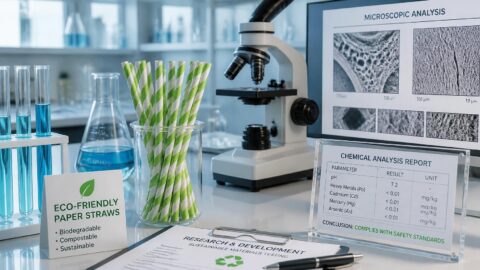
While paper straws were adopted as an eco-friendly alternative to plastic, scientific studies revealing the presence of PFAS have complicated their environmental and health narrative.
PFAS (per- and polyfluoroalkyl substances) is a group of more than 15,000 synthetic chemicals prized for their ability to repel water, oil, and grease. They’re used in raincoats, nonstick cookware, firefighting foam, food packaging, and — as it turns out — many paper straws, likely as a water-resistant coating. Their defining feature, an extremely strong carbon-fluorine bond, is exactly what makes them so useful industrially and so persistent environmentally: they resist breaking down for years, sometimes decades or longer, both in the environment and inside the human body.
The 2021 US study (Timshina et al., published in Chemosphere) was the first to test straws sold in the United States for PFAS. It examined plastic, paper, and other plant-based straws and found PFAS compounds in the paper and plant-based samples, while the plastic straws tested showed no measurable PFAS.
The 2023 Belgian study (Groffen et al., University of Antwerp, published in Food Additives and Contaminants) tested 39 straw brands across five materials — paper, bamboo, glass, stainless steel, and plastic — sold in Belgium, for 29 individual PFAS compounds. The results:
Perfluorooctanoic acid (PFOA) was the most frequently identified compound. Notably, a paper straw brand recorded the single highest PFAS concentration of any product tested.
Researchers aren’t entirely certain. The leading theory is that PFAS compounds are intentionally added during manufacturing as a water-repellent coating, since paper is inherently absorbent and would otherwise disintegrate quickly in a drink. A secondary possibility is contamination through raw materials or water used somewhere in the supply chain. The Belgian researchers concluded it was likely a mix of both, but couldn’t rule either explanation out definitively.
Here’s where the nuance matters. Researchers involved in the studies have been fairly consistent in their message: the PFAS concentrations detected in straws were low, and because people generally use straws only occasionally and for short periods, the acute health risk from any single straw is limited. The concern isn’t that one paper straw will make you sick — it’s cumulative exposure. PFAS builds up in the body over time and doesn’t clear out easily, so repeated low-level exposure across many products (straws, food packaging, cookware, textiles) adds to a person’s total chemical burden. As University of Antwerp researcher Dr. Thimo Groffen put it, small amounts “while not harmful in themselves, can add to the chemical load already present in the body.”
There’s also an end-of-life dimension: if PFAS-containing straws are composted, recycled, incinerated, or landfilled, the chemicals can persist and potentially migrate into soil, air, or new products made from recycled material — undermining part of the environmental case for choosing paper in the first place.
| Material | PFAS Detected (Belgian study) | Biodegrades Quickly | Typical Cost |
| Paper | 90% of brands | Yes | Low-moderate |
| Bamboo | 80% of brands | Yes | Moderate |
| Plastic | 75% of brands | No (centuries) | Lowest |
| Glass | 40% of brands | N/A (reusable) | High (reusable) |
| Stainless steel | 0% of brands | N/A (reusable) | High (reusable) |
Stainless steel is the only material tested with zero detected PFAS across the sample, which is why several researchers involved in this line of study specifically recommend it — or simply skipping a straw altogether — for anyone concerned about PFAS exposure.
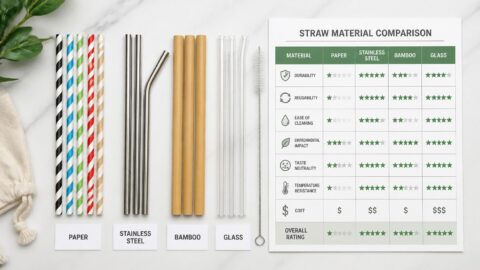
Laboratory testing across multiple materials shows varying rates of PFAS presence, highlighting stainless steel as the only material with zero detected chemicals.
Not necessarily — it depends what you’re measuring. On PFAS specifically, paper straws tested worse than plastic in the available research. On environmental persistence and marine litter, plastic remains the far bigger long-term problem, since it doesn’t biodegrade and is a well-documented contributor to ocean pollution and wildlife harm. The honest takeaway from the current research is that neither material is a clean win across every dimension, which is exactly the argument the 2025 federal executive order leaned on — see our breakdown of that policy shift — even though the order’s claim that plastic straws contain “no measurable PFAS” overstates what the actual data shows.
Do all paper straws contain PFAS? No, but the majority tested in available studies did — roughly 90% of paper straw brands in the 2023 Belgian study. PFAS-free paper straws do exist and are increasingly marketed as such.
Are plastic straws PFAS-free? No. Despite claims to the contrary, studies have detected PFAS in a majority of plastic straws tested as well, generally at lower concentrations than in paper straws.
Which straw material has no PFAS? Stainless steel was the only material with zero PFAS detected across all samples in the 2023 Belgian study.
Should I stop using paper straws? Most researchers say occasional use isn’t a major individual health risk, but if you’re concerned about cumulative PFAS exposure, reusable stainless steel is the lowest-risk option based on current data.
