For millions of international visitors passing through Changi Airport each year, Singapore often serves as both a destination and a gateway to the wider region. As one of the world’s most awarded airports and a country that markets itself heavily on cleanliness, efficiency, and increasingly, sustainability, the small details of a visitor’s experience — including something as minor as the straw in an airport café drink — contribute to broader impressions of Singapore as a forward-thinking, environmentally conscious destination.

For millions of international visitors passing through Changi Airport, small sustainability touchpoints like paper straws offer an immediate first impression of Singapore’s forward-thinking tourism experience.
Changi Airport, operated by the Changi Airport Group, has positioned sustainability as a core part of its brand identity, alongside its famous Jewel complex, indoor gardens, and butterfly enclosures. F&B outlets throughout the airport’s terminals — from quick-service coffee kiosks to sit-down restaurants in the transit areas — have largely transitioned to paper straws over recent years, often as part of broader airport-wide sustainability directives affecting all tenant businesses operating within Changi’s terminals.
For transiting passengers with only a few hours in Singapore, these small packaging details can shape perceptions of the country before travelers even leave the airport grounds. Business travelers and tourists arriving from regions where plastic straw bans are already common often view paper straws as an unremarkable baseline expectation, while others encountering the shift for the first time have noted it as a distinctly Singaporean touch reflecting the country’s broader emphasis on environmental planning.
Beyond the airport, major tourist attractions across Singapore — including Gardens by the Bay, Sentosa Island’s various resorts and theme parks, and the Singapore Zoo and Night Safari managed by Mandai Wildlife Group — have incorporated paper straws into their F&B outlets as part of broader sustainability commitments tied to their conservation and environmental education missions.
Mandai Wildlife Group in particular has leaned into sustainability messaging as central to its brand, given its conservation-focused mission, making paper straws and other single-use plastic reductions at its F&B outlets a natural extension of the broader environmental narrative visitors encounter throughout their visit to the zoo, river safari, and night safari attractions.
| Traveler Origin | Typical Reaction |
|---|---|
| From regions with established plastic bans (EU, parts of Australia) | Sees paper straws as expected baseline |
| From regions where paper straws are uncommon | Notices and appreciates the detail |
| Business travelers in transit | Minimal awareness, brief impression only |
| Family travelers with young children | Often positive, seen as a small teachable moment |
| Repeat visitors to Singapore | Notice the shift as part of a broader pattern of change over multiple trips |
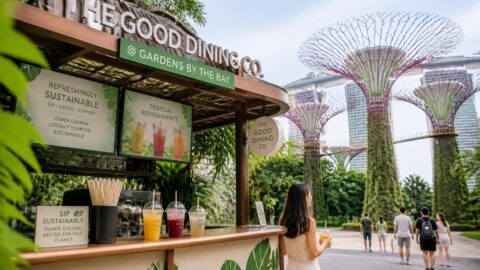
Aligning with their conservation missions, major Singapore attractions like Gardens by the Bay and Mandai Wildlife Group incorporate paper straws across their F&B outlets.
Singapore Tourism Board has increasingly promoted sustainability as part of the country’s broader tourism positioning, recognizing that environmentally conscious travelers — particularly from Europe, Australia, and increasingly parts of North America — factor sustainability credentials into destination and activity choices. While paper straws represent an extremely small element within this positioning, they function as an accessible, visible touchpoint that reinforces broader messaging around Singapore’s Green Plan 2030 and its ambitions to be recognized as a model sustainable city.
Tour operators and hospitality partners working with the Tourism Board have, in various promotional materials, referenced sustainable dining and packaging practices as part of curated eco-tourism itineraries, positioning paper straws as one small element within broader experiences like nature reserve visits, sustainable seafood dining experiences, and green building tours.
International visitor feedback on Singapore’s paper straw adoption has generally been positive, though not without occasional critique. Some travelers from countries with more established plastic reduction policies have noted that Singapore’s approach — largely voluntary and industry-led rather than legislated — lags slightly behind jurisdictions with outright bans, even as they acknowledge the country’s broader environmental infrastructure, such as its extensive public transit system and green building standards, often exceeds expectations.
Other visitors, particularly from markets where paper straws remain uncommon, have expressed genuine surprise and appreciation at encountering them consistently across F&B outlets throughout their trip, citing it as a small but memorable detail that reinforced Singapore’s reputation for meticulous planning and forward-thinking infrastructure.
Does Changi Airport require all F&B outlets to use paper straws? Many outlets have transitioned as part of airport-wide sustainability directives, though practices can vary somewhat by individual tenant and outlet type.
Do Singapore’s tourist attractions have their own sustainability policies? Yes — attractions like Mandai Wildlife Group tie single-use plastic reduction directly to their conservation-focused missions, making paper straws a natural extension of their broader environmental messaging.
Is Singapore’s tourism sustainability approach stricter than other countries? It’s generally more voluntary and industry-led compared to jurisdictions with outright plastic bans, though its broader environmental infrastructure is often highly regarded by international visitors.
Do tourists notice or care about paper straws during short visits? Reactions vary — travelers from regions with existing plastic reduction policies barely notice, while those from markets where paper straws are uncommon often view it as a distinctive and positive detail.
For a country whose tourism brand rests heavily on precision, cleanliness, and future-forward urban planning, paper straws serve as an unexpectedly fitting symbol — a small, tangible detail that visitors encounter repeatedly throughout their stay, reinforcing broader impressions shaped by Singapore’s gardens, green buildings, and environmental messaging. As Singapore continues to court sustainability-minded travelers in an increasingly competitive regional tourism market, these small details are likely to remain a quiet but consistent part of the visitor experience for years to come.