Western Australia doesn’t just ban plastic straws — it runs one of the broadest single-use plastics restrictions in the country. If you’re operating a cafe, bar or restaurant in Perth, the safest approach isn’t asking “have I dealt with straws?” but “have I actually checked my whole disposables list against WA’s rules?” Many Perth businesses assume that switching their straws covers them, then discover months later that other items in their kitchen or counter display are still technically non-compliant.

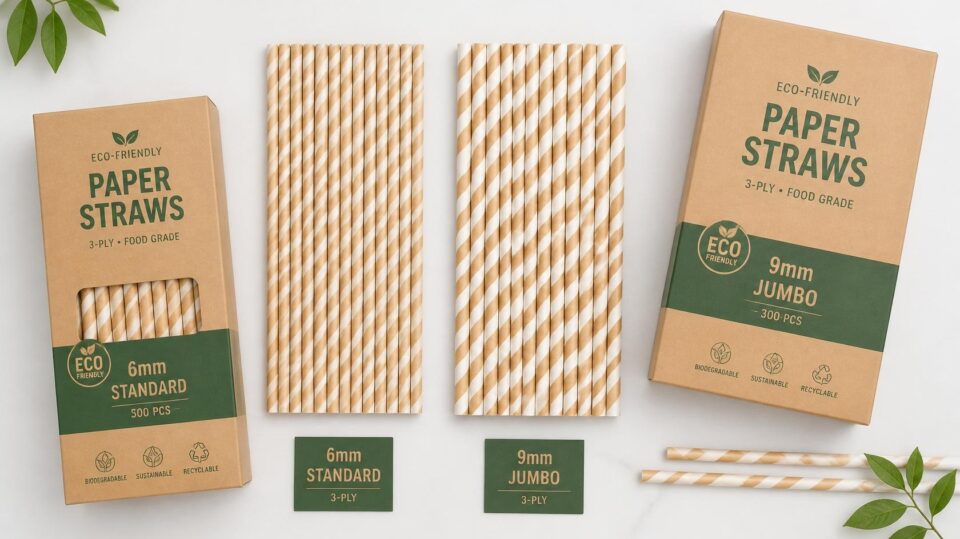
Ensuring full compliance with Western Australia’s strict single-use plastics ban starts with choosing certified, reliable paper straws for your Perth venue
WA’s first round of restrictions, from 2022, covers:
From 1 October 2025, the ban on disposable produce bags extended further, to dry goods and confectionery, not just loose fruit and vegetables. That’s a wider list than most Australian states, and it’s worth reading in full rather than assuming your existing supplies are covered. Businesses that only ever check the straw rule tend to be the ones who get caught out by the cup rule, or the produce bag rule, months later.
WA specifically bans non-compostable single-use cups — a restriction Queensland, for example, doesn’t currently have. Businesses that switch their straws but leave their cups unchanged are still non-compliant, even though “we switched our straws” often becomes the answer staff give when asked about sustainability compliance. If you’ve only addressed drinking straws so far, it’s worth treating this as one item on a longer list, not the whole task. The same logic applies to produce bags: a cafe that sells packaged snacks or confectionery in disposable bags needs to check the October 2025 update specifically, since it’s a newer and less well-known change than the original 2022 rules.
Because WA’s list is genuinely the broadest in the country, the cost of getting this wrong compounds. A venue that’s only handled straws is exposed on cups, bags and polystyrene packaging simultaneously — three separate compliance gaps instead of one. It’s far more efficient to do a single, complete review of your disposables now than to fix each category one at a time as it gets flagged.
| Use case | Recommended straw |
|---|---|
| Coffee, soft drinks, juice | Standard 6mm, 3-ply |
| Smoothies, milkshakes, thick drinks | Jumbo 9mm, 3-ply |
| High-volume venues | Bulk cartons, 3,000–5,000 units |
| All uses | Water-resistant coating, certified compostable |
A generic “biodegradable” label on a straw isn’t the same as certified compostable, and given how strictly WA enforces its rules, it’s worth confirming your supplier can produce actual certification rather than marketing language. This distinction matters more in WA than in states with a narrower list, since a broader compliance regime tends to come with closer scrutiny of exactly what “compostable” means on a product label.
Choosing the correct size and certified 3-ply, water-resistant paper straws helps Perth businesses meet stringent WA environmental regulations
Perth’s dry climate is actually kinder to paper straws than the humidity found in Queensland or the Northern Territory, but it’s still worth storing cartons somewhere cool and dry, away from direct sunlight, particularly during summer when storeroom temperatures can climb. Straws stored badly can degrade before they’re even used, which defeats the purpose of buying a quality product in the first place.
We supply certified compostable paper straws in bulk across the Perth metro area — CBD, Fremantle, Scarborough and the northern suburbs — and can talk through your wider packaging list if you’re reviewing cups, bags and straws together rather than one at a time. For venues that haven’t yet reviewed their full disposables range against WA’s rules, we’re happy to walk through what’s covered and what isn’t, rather than just selling straws in isolation.
Contact us for wholesale pricing and delivery across Perth.
Regulations referenced reflect Western Australia’s plastics ban current as of July 2026. Always confirm current requirements with the WA Government before making compliance decisions.