Compostable straws have become common enough across Singapore’s cafés, hawker centres, and bubble tea shops that most people have opinions about them — not all of those opinions are accurate. Here are the most persistent myths specific to the Singapore context, and what’s actually true.
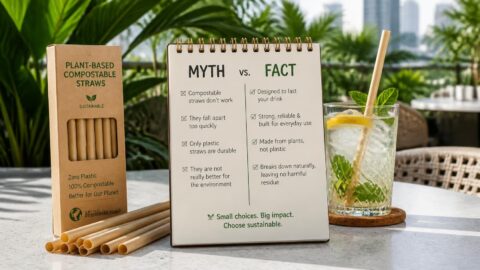
From assumptions about local kitchen composting to misconceptions about plastic straw bans, compostable straws in Singapore are surrounded by persistent myths. Let’s separate fact from fiction.
Reality: As covered in our composting infrastructure guide, most household waste in Singapore is incinerated rather than composted, since large-scale municipal composting access remains limited across much of the island. A compostable straw thrown into a regular kitchen bin most likely ends up at a Waste-to-Energy plant, not a compost heap — a very different (though not necessarily harmful) outcome.
Reality: Even when incinerated rather than composted, compostable straws are still made from renewable plant-based materials rather than petroleum, generally carry a lower production footprint, and avoid contributing to persistent microplastic pollution. The environmental benefit is different from full composting, but it isn’t zero.
Reality: There is no nationwide blanket ban on plastic straws in Singapore. The widespread adoption seen across F&B chains, cafés, and bubble tea shops has largely been driven by voluntary corporate sustainability commitments and consumer expectation, not legal mandate — a distinction covered in more detail in our regional comparison guide.
Reality: While some compostable straws are imported, Southeast Asia’s growing regional manufacturing base — particularly for sugarcane bagasse — has made sourcing increasingly competitive, and local Singapore distributors now offer a range of options at accessible price points for businesses of different sizes.
Reality: Humidity can affect storage if straws aren’t kept properly (dry, sealed packaging, away from direct moisture exposure), but well-manufactured compostable straws, properly stored, perform reliably in Singapore’s climate — the same way they do in other humid Southeast Asian markets already using them at scale.
Reality: As covered in our bubble tea-specific guide, wide-diameter sugarcane bagasse straws have become a common, well-performing solution for boba drinks across many Singapore bubble tea chains — the early durability concerns from years ago have largely been addressed by improved material engineering.
Reality: While compostable straws do cost more per unit than plastic, the actual cost difference for a typical hawker stall’s straw volume is often modest in absolute terms, and group purchasing through hawker centre associations can further reduce the gap, as discussed in our Singapore cost guide.
Reality: As with global markets, “eco-friendly” is a loosely used marketing term in Singapore too. Genuine compostability should be backed by recognized certifications like BPI, TÜV Austria OK Compost, or EN 13432 — not assumed from packaging language alone.
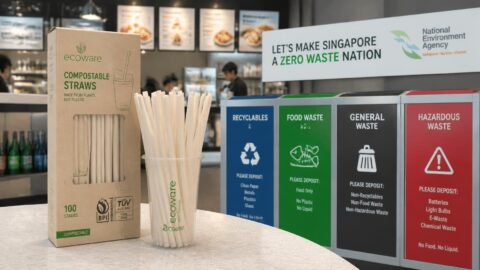
Understanding Singapore’s incineration-based waste system and looking for trusted certifications like BPI or TÜV Austria ensures your sustainability choices are grounded in local reality.
| Myth | Fact |
|---|---|
| Composts in a home kitchen bin | Usually incinerated via Singapore’s waste system instead |
| Pointless if not composted | Still offers renewable sourcing and microplastic-free benefits |
| Singapore has a plastic straw ban | No nationwide ban; adoption is largely voluntary |
| Always imported and expensive | Regional sourcing has improved cost-competitiveness |
| Can’t handle local humidity | Fine with proper storage practices |
| Unsuitable for bubble tea | Wide bagasse straws now widely used successfully |
| Too costly for hawker stalls | Modest cost gap, further reducible via group purchasing |
| “Eco-friendly” label = certified compostable | Only recognized certifications confirm genuine compostability |
Singapore’s unique waste infrastructure — heavy reliance on incineration, limited but growing composting access, and a business culture that favors voluntary sustainability commitments over blanket bans — means generic global information about compostable straws doesn’t always translate directly to local reality. Understanding the Singapore-specific picture helps both businesses and consumers set accurate expectations rather than either overestimating or dismissing the impact of switching.
Why do so many myths about compostable straws specifically involve composting infrastructure in Singapore? Because Singapore’s waste system genuinely differs from many countries used as reference points in general compostable product marketing — most global content assumes landfill or widespread composting access, neither of which reflects Singapore’s incineration-based system accurately.
Is it worth asking F&B businesses in Singapore where their compostable straws actually end up? Yes — it’s a fair and increasingly common question, and businesses genuinely committed to closing the loop should be able to explain their disposal pathway, whether that’s commercial composting collection or standard waste handling.
Are these myths unique to Singapore, or do they apply elsewhere too? Some (like the “eco-friendly equals certified” myth) are global misconceptions, while others (like assuming home composting is automatic) are especially relevant given Singapore’s specific waste infrastructure.
Cutting through myths about compostable straws in Singapore comes down to understanding the local context — the waste system, the regulatory approach, and the regional supply landscape — rather than applying assumptions from other countries’ experiences. With accurate information, businesses and consumers alike can make genuinely informed choices rather than decisions based on misconception in either direction.
Compostable straws remain a worthwhile choice for Singapore’s F&B scene — as long as expectations are grounded in how the country’s waste and sustainability systems actually work.
