If you run a bar, restaurant, hotel, or beverage brand in Germany, you’ve almost certainly had to adapt to one major piece of legislation: the EU Single-Use Plastics Directive (Directive (EU) 2019/904). Understanding exactly what this law requires — and how Germany implemented it — helps businesses stay compliant while choosing the right paper straw suppliers.
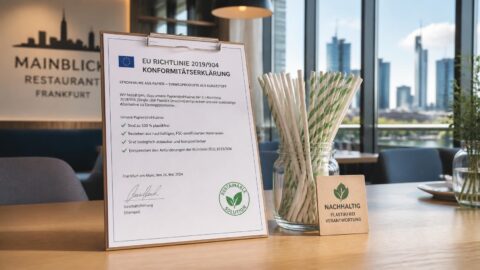
When the EU Single-Use Plastics Directive and Germany’s EWKVerbotsV ordinance took effect in July 2021, it permanently transformed the country’s hospitality landscape, making reliable, compliant paper straws an operational necessity for every café, bar, and hotel
Adopted in 2019, the directive targets the ten single-use plastic items most frequently found on European beaches, straws among them. The EU’s goal was straightforward: reduce marine litter and plastic pollution by eliminating or restricting the plastic products with the most viable non-plastic alternatives already on the market.
Plastic drinking straws were included in the Annex B ban list, meaning EU member states were required to prohibit the placing of these products on the market entirely — not just discourage their use.
Germany transposed the directive into national law through the Einwegkunststoffverbotsverordnung (EWKVerbotsV) — the Single-Use Plastics Prohibition Ordinance — which came into force on July 3, 2021. From that date forward:
| Date | Milestone |
|---|---|
| June 2019 | EU adopts Single-Use Plastics Directive |
| 2019–2021 | EU member states draft national transposition laws |
| July 3, 2021 | Germany’s ban on plastic straws (and other SUP items) takes effect |
| 2021–present | Continued monitoring, market surveillance, and consumer education |
The directive doesn’t prescribe one specific replacement material — it simply bans plastic ones. As a result, the German market has seen a wide mix of alternatives:
PLA straws are often marketed as “compostable,” but they typically require industrial composting facilities to break down properly. Because Germany’s ordinance defines “plastic” broadly enough to include some biobased and biodegradable polymers, PLA straws exist in a gray area depending on their exact composition — which is one reason paper straws remain the dominant, unambiguous choice for compliance.
Paper straws avoid the regulatory ambiguity that surrounds bioplastics. They’re inexpensive to produce at scale, widely recyclable through standard paper waste streams, and increasingly available in fully biodegradable formulations that satisfy both legal requirements and consumer sustainability expectations.
For hospitality businesses, three factors typically drive the switch to paper straws:

Navigating Germany’s strict market surveillance and regulatory standards requires businesses to maintain clear documentation, supplier certifications, and verified material specifications to ensure seamless compliance with national environmental laws.
When exactly did the plastic straw ban start in Germany? The ban took effect on July 3, 2021, under the EWKVerbotsV ordinance implementing the EU directive.
Are reusable plastic straws still allowed? The ban targets single-use plastic straws. Durable, reusable plastic straws designed for repeated use generally fall outside the single-use category, though businesses should verify classification carefully.
Is it illegal for a business to still have old plastic straw stock? The ordinance restricts placing these products on the market, which generally includes selling or distributing existing stock — businesses should not continue distributing pre-ban inventory.
Do imported paper straws need special certification for Germany? There’s no single mandatory certification for paper straws themselves, but sustainability claims (biodegradable, compostable) should be backed by recognized standards to avoid greenwashing concerns.
German market surveillance authorities, working at both federal and state (Länder) level, are responsible for monitoring compliance with the EWKVerbotsV ordinance. In practice, enforcement has focused primarily on manufacturers and large-scale distributors rather than individual small businesses caught with leftover stock, though the legal exposure technically applies across the supply chain. Fines for continued distribution of banned single-use plastic items can be substantial, and repeated violations carry escalating penalties under German administrative law.
For businesses, the practical takeaway is straightforward: once the transition deadline passed in July 2021, any plastic straw inventory should have been phased out of active use, and procurement teams should treat plastic straws as entirely off the table for future ordering — regardless of how they’re packaged or marketed.
Germany’s implementation timeline and approach broadly mirrored other EU member states, since all were bound by the same 2021 transposition deadline under the directive. However, enforcement intensity and market surveillance resources have varied somewhat by country. Germany’s strong existing culture of waste regulation and recycling infrastructure meant the transition faced relatively low public resistance compared to some other markets, where compliance and consumer adaptation took longer to normalize.
