Behind every paper straw sitting in a German café’s drink is a manufacturing process that blends traditional papermaking with precision engineering. For business owners sourcing straws — or curious consumers wondering what actually goes into that seemingly simple tube — here’s a full breakdown of how paper straws move from raw pulp to a finished product ready for your iced coffee.
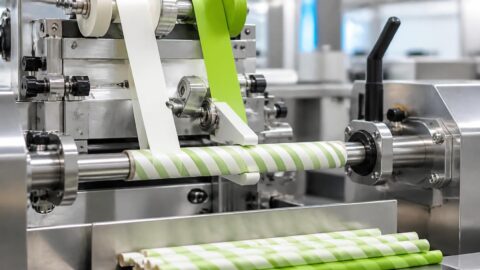
Behind every reliable paper straw in a German café lies an intricate manufacturing process combining sustainable raw materials, precision spiral winding, food-safe adhesive bonding, and rigorous quality control.
Most quality paper straws start with food-grade kraft paper, chosen for its strength-to-weight ratio and natural fiber structure. Reputable manufacturers source this paper from FSC-certified (Forest Stewardship Council) suppliers, ensuring the wood pulp comes from responsibly managed forests.
Paper weight matters enormously here. Straws typically use paper in the range of 60–120 grams per square meter (gsm), with multiple layers combined to achieve the durability needed to survive a drink.
If a straw includes color, patterns, or branding, printing happens before the paper is rolled into tube form. Manufacturers use food-safe, water-based inks rather than solvent-based inks, both for safety and to avoid interfering with the paper’s biodegradability.
Large paper rolls are sliced into narrow strips — the exact width depends on the final straw diameter (standard drinking straws, wide bubble-tea straws, or cocktail stirrer sizes all require different strip widths).
This is the core of straw manufacturing. The paper strips feed into a spiral-winding machine, which wraps them around a rotating mandrel (a metal rod) at a precise angle. Multiple layers — usually two to four — are wound simultaneously to build wall thickness and strength.
| Layer Count | Typical Use Case | Relative Sturdiness |
|---|---|---|
| 2-layer | Cold beverages, short use | Moderate |
| 3-layer | Standard cafés, both hot/cold drinks | High |
| 4-layer | Smoothies, bubble tea, extended use | Very high |
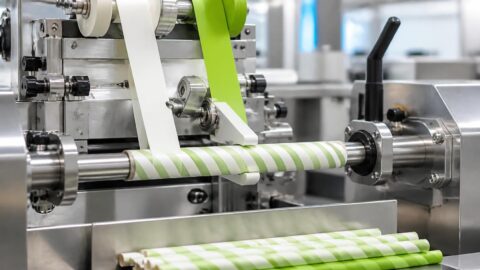
The core of paper straw production relies on advanced spiral-winding technology, where multiple layers of FSC-certified kraft paper and food-safe plant-based adhesives are wound simultaneously at precise angles to ensure optimal structural strength.
Between each layer, a thin line of food-safe adhesive bonds the paper together as it winds around the mandrel. This is one of the most important — and most scrutinized — parts of the process.
Once the continuous spiral tube exits the winding machine, high-speed rotary blades cut it into individual straws at the desired length — typically 197mm for standard straws or 240mm+ for bubble tea and smoothie straws.
Many paper straws receive a thin wax or bio-based lacquer coating on the interior surface to slow down sogginess. This step separates budget straws from premium ones:
Straws pass through a controlled drying tunnel to cure the adhesive and any coating fully. Proper curing time is critical — under-cured straws can unravel or weaken prematurely.
Before packaging, manufacturers test straws for:
Finished straws are counted, wrapped (often in individual paper sleeves for hygiene, or bulk-packed for foodservice use), and labeled. Reputable manufacturers attach certification documentation — such as EN 13432 compostability test results — at this stage for B2B buyers.
Why do some paper straws go soggy faster than others? It usually comes down to layer count, adhesive quality, and whether an interior coating was applied. Cheaper 2-layer uncoated straws soften fastest.
Is the printing ink on colored paper straws safe? Reputable manufacturers use food-safe, water-based inks approved for direct food contact, but always verify with your supplier’s safety documentation.
Can paper straw manufacturing be scaled for large wholesale orders? Yes — modern spiral-winding lines can produce thousands of straws per hour, and many EU-based manufacturers have significantly expanded capacity since the 2021 plastic straw ban.
Understanding the manufacturing process helps businesses ask the right questions when vetting suppliers — because not all “paper straws” are built the same way, and the difference shows up the moment a customer takes their first sip.
