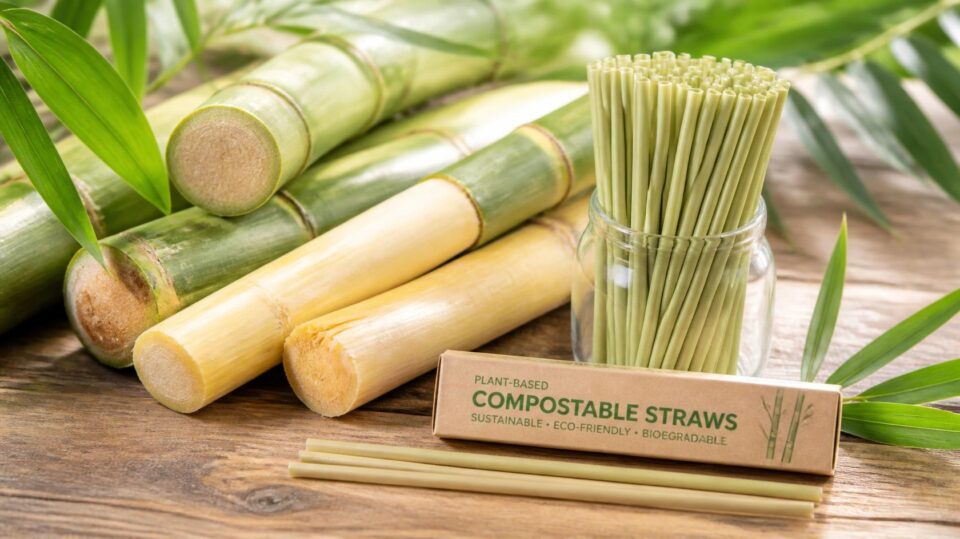
Cost is almost always the first question Singapore F&B operators ask when considering compostable straws. Between GST, import logistics, and Singapore’s higher operating costs compared to some neighboring markets, the numbers deserve a closer look than a generic global price guide can offer.
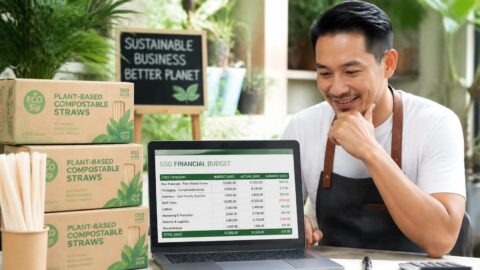
While compostable straws carry a higher unit price in Singapore dollars (SGD) than conventional plastic, factoring in GST, bulk consolidation, and group purchasing makes the financial transition manageable for local F&B operators.
| Straw Type | Price per 1,000 Units (SGD) | Price per Straw |
|---|---|---|
| Conventional plastic | S$10–S$18 | S$0.010–S$0.018 |
| Paper (uncoated) | S$15–S$25 | S$0.015–S$0.025 |
| Compostable PLA | S$22–S$38 | S$0.022–S$0.038 |
| Sugarcane bagasse | S$20–S$35 | S$0.020–S$0.035 |
These figures are before GST and before any volume discounts, which can shift the picture significantly.
Singapore’s GST applies to most straw purchases, whether sourced locally or imported, and businesses should factor this into landed cost calculations. For imported compostable straws specifically, also account for:
A straw priced attractively at the factory gate overseas can end up costing considerably more once these layers are added — which is why many small and mid-size Singapore businesses find local distributors more cost-predictable, even at a slightly higher headline unit price.
| Order Volume | Typical Price Reduction |
|---|---|
| Under 5,000 units | Baseline pricing |
| 10,000–50,000 units | 10–20% lower per unit |
| 100,000+ units | 20–35% lower per unit |
| 500,000+ units (chain-level bulk) | 30–45% lower per unit |
Singapore’s compact geography is actually an advantage here — businesses across multiple outlets on the island can consolidate orders into a single delivery more easily than chains spread across a larger country, helping smaller multi-outlet operators access better bulk pricing sooner.
Assume a 5-outlet bubble tea chain in Singapore uses 40,000 straws per month combined:
| Straw Type | Monthly Cost (SGD) | Annual Cost (SGD) |
|---|---|---|
| Conventional plastic | ~S$560 | ~S$6,720 |
| Sugarcane bagasse (bulk) | ~S$960 | ~S$11,520 |
The annual difference in this example is roughly S$4,800 across five outlets — about S$960 per outlet per year, often comparable to a single month’s utility bill for a small F&B unit, and frequently offset by the marketing value of a visible sustainability commitment in a market where customers increasingly notice it.
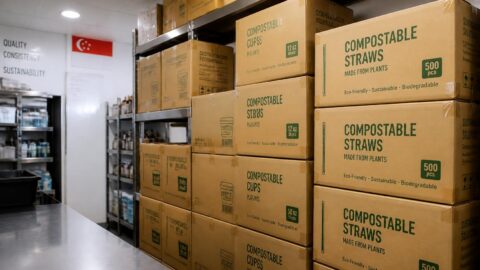
Consolidating orders across multiple outlets throughout Singapore’s compact geography allows businesses to access lower bulk tiers and reduce overall operating costs.
Is GST charged on compostable straws the same way as regular packaging? Yes, standard GST rules apply to compostable straw purchases in Singapore, whether sourced locally or imported, as with most business packaging supplies.
Are there any government grants in Singapore to help offset the cost of switching? Businesses should check current schemes under national sustainability and productivity grant programs, as eligibility and available support can change; consulting with a business advisory service or industry association is a practical way to stay updated.
Is it cheaper for a small café to switch than a large chain? Per unit, large chains typically achieve better bulk pricing, but small cafés face a smaller total cost increase in absolute dollar terms given lower overall volume — both scales are financially manageable with proper planning.
The cost gap between compostable and conventional plastic straws in Singapore is real but manageable, particularly once GST, bulk discounts, and group purchasing strategies are factored into the full picture. For most F&B businesses, the annual cost difference amounts to a modest, budgetable expense rather than a barrier to switching.
Compostable straws are within financial reach for Singapore businesses of nearly every size — the key is planning the numbers properly rather than reacting to sticker price alone.